
The history of Bandai-Namco is the story of two cultural titans that walked in parallel for decades. On one side, Namco: an arcade pioneer and the creator of some of the most universal icons in video game history. On the other, Bandai: a toy and licensing giant, with an unfailing instinct for turning franchises into global phenomena.
When both companies merged in 2005, they didn’t just combine resources, they combined languages. From the ghosts of Pac-Man to the warriors of Dragon Ball, Bandai Namco has kept the essence of Japanese entertainment alive while projecting it onto the world through a powerful multimedia presence.
This is the story of how two different worlds met, complemented each other… and conquered screens.
1. Namco’s roots (1955-1977)
From mechanical horse rides to Japanese arcades
Before becoming synonymous with video games, Namco began in a far more modest corner of the entertainment world. Founded in postwar Japan, the company was born to install and maintain electric horse rides in shopping centers, offering an accessible form of family entertainment. Those early machines were not video games, but they already hinted at a key intuition: the power of play as a social experience.
Entertainment engineering before video games
· Founding as Nakamura Manufacturing
In 1955, Masaya Nakamura founded the company with a simple goal: to install and maintain mechanical horse rides in shopping centers. These early devices were primitive versions of automated entertainment, and little by little, Namco expanded its presence in public venues.
· Evolution of mechanical entertainment
During the 1960s, Namco completely moved away from repairing horse rides and focused its business on mechanical games. In 1970, it changed its name to Nakamura Amusement Machine Manufacturing Company, and was already commonly identified simply as Namco. The company began to diversify its catalogue of mechanical arcade machines. These were some of the products that defined this stage:
- Roadway Race: a driving game with a rotating track on which a car controlled by the player would move. It represented a significant advance in visual complexity and gameplay for the time.
- Shooting Trainer: a light gun shooting game where players fired at illuminated moving targets. This type of attraction anticipated the public’s taste for direct interaction.
- Coin-operated horse rides and attractions: Namco did not only install them, but was also responsible for their continuous operation, which cemented its reputation as a reliable company.
With these first steps, Namco was no longer just a provider of attractions: it was an entertainment company. Masaya Nakamura had understood that the future was not only in the machines, but in the player’s experience.
· First steps into video games
In a visionary move, in 1974, Namco acquired Atari’s Japanese division and began operating arcade machines in Japan. It was a key decision that marked its entry into the world of video games. A year later, Namco created its first game: Gee Bee (1977), a title inspired by Breakout, but with its own twist. Gee Bee was not a massive success, but it was a crucial step that allowed Namco to gain experience in video game design, laying the foundations for its future dominance in the arcade scene.
· Building solid foundations
During this early stage, Namco committed to in-house development, forming design teams that would later bring to life some of the most influential titles in history. The company was preparing, without knowing it, to revolutionize arcade halls all over the world.
“Namco was not born making video games, but from its very first machines it already understood the essential truth: play is serious business.”
2. From Japan to the world (1979-1983)
International expansion and the birth of a star
After years of learning within the entertainment industry, Namco was ready to take a leap beyond Japan’s borders. The arcade world was in full effervescence, and Namco knew how to seize the exact moment to place itself at the center of the stage.
When Japan taught the world how to play
· Expansion into the United States
In 1979, Namco opened its first subsidiary in the United States: Namco America Inc., a strategic move to directly control the distribution of its titles in the Western market, which until then had been dominated by companies such as Atari. This move would prove decisive in the years to come.
· The birth of an icon: Pac-Man
Conceived by Toru Iwatani and released in 1980, Pac-Man was not just a success: it was a global cultural phenomenon. Moving away from the warlike aesthetics and space shooters of the time, Pac-Man introduced bright colors, recognizable characters, and accessible gameplay for all kinds of audiences. It was one of the first video games to feature a charismatic character backed by massive marketing.
· Ms. Pac-Man and the expansion of the phenomenon
One year later, and developed without Namco’s initial consent by General Computer Corporation and distributed by Midway, Ms. Pac-Man became a milestone. Its success reinforced the appeal of the character, and despite its accidental origin, Namco would eventually accept it as an official part of the franchise.
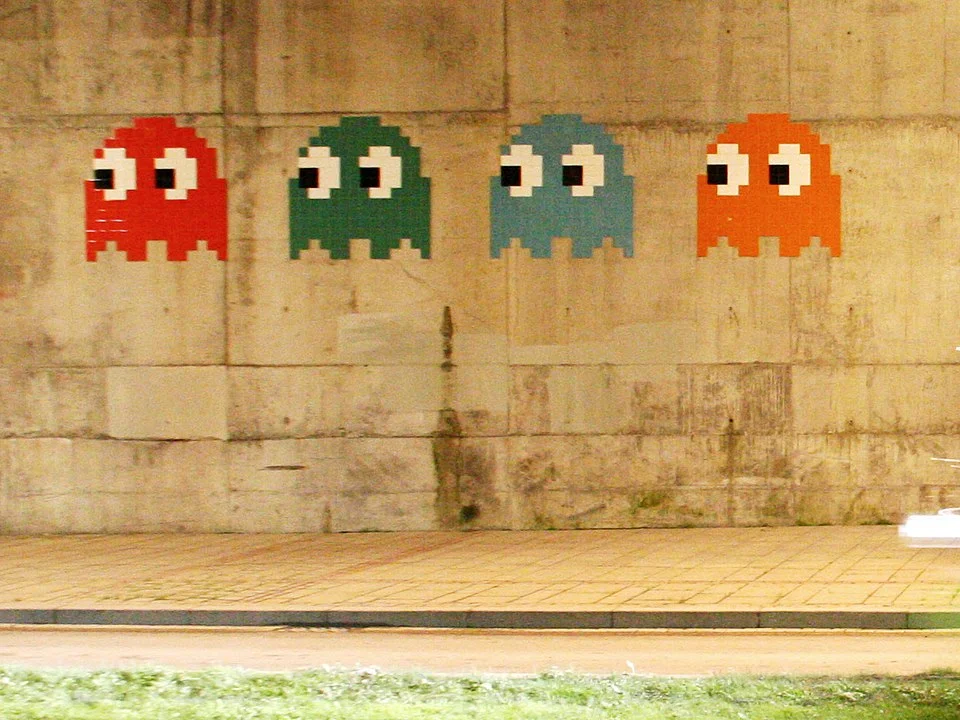
Image credit: kurtxio (Wikimedia Commons) – CC BY 2.0 – Unmodified image
· Other hits of the era
Namco did not stop there. During this period, it released other influential games:
- Galaxian (1979) and Galaga (1981): space shooters that refined the formula started by Space Invaders.
- Rally-X (1980): the first arcade game with scrolling screens and a minimap.
- Dig Dug (1982): featuring underground mechanics and original characters.
- Xevious (1983): a vertical scrolling shooter with two firing layers (air and ground).
· A distinct style and philosophy
Unlike other companies, Namco embraced a more colorful aesthetic, characters with strong identity, and more approachable mechanics, which attracted a broader audience, including women and families.
“While others were shooting into space, Namco was designing worlds you wanted to live in.”
3. The pulse of the arcade (1984–1994)
Consolidation, licensing, and a distinct identity
The 1980s finished shaping Namco into one of the titans of the arcade industry. Far from settling for the success of Pac-Man, the company explored new genres, refined its visual style, and began operating as a global licensor. While other firms disappeared after the crash of ’83, Namco knew how to adapt, diversify, and lead.
Namco consolidates its identity after the crash
· The resurgence after the crash
Although the video game industry crash of 1983 mainly affected the U.S. market, it also had an impact on Japan. Namco weathered the storm by maintaining its focus on quality, originality, and direct control over its products, both hardware and software.
· International licensing
During this period, Namco consolidated strategic alliances with international manufacturers. In the U.S., for example, many of its games were distributed by Midway or Atari, while in Europe they worked with companies such as Atari Games and Taito. This model allowed for massive distribution without losing its own identity.
· Technical and thematic innovation
Namco continued to push the limits of the arcade in terms of mechanics and technology:
- Tower of Druaga (1984): a blend of RPG and action, a precursor to games like The Legend of Zelda.
- Baraduke (1985): a shooter with a dark setting, starring a female protagonist (something unusual at the time).
- Sky Kid (1985): a cooperative side-scrolling aviation game.
- Rolling Thunder (1986): side-scrolling action with cover mechanics, key in the development of run & gun.
- Splatterhouse (1988): one of the first explicitly horror-themed arcade games.
· Aesthetic and sound as a trademark
During these years, Namco titles were characterized by their sharp sprites, vibrant backgrounds, and outstanding sound design. Many of their melodies were composed by artists from the Namco Sound Team, a unit that elevated arcade music to another level.
· A multi-platform company
In addition to arcades, Namco began releasing games on consoles such as the Famicom and later on the Super Famicom or Mega Drive, adapting its hits to home formats. While it never abandoned arcades, this move broadened its target audience.
“In an era of imitation, Namco offered worlds with a soul of their own.”
4. Namco in the polygonal era (1994–2005)
From 2D to 3D: the transition to consoles, technical success, and gradual wear
The arrival of 3D marked a turning point in the video game industry, and Namco did not fall behind. Far from clinging to the past, the Japanese company embraced the new era with a mix of technical innovation and competitive spirit. From arcade halls to new-generation consoles, Namco was one of the key architects of the polygonal leap, leaving an indelible mark on genres such as fighting games, racing, and on-rails shooters.
However, in this process of expansion and diversification, its identity as a brand also began to blur. This stage was, at the same time, a creative peak and the beginning of a silent wear.
From polygonal arcades to the digital home
· A new battlefield: home consoles
During the 1990s, the video game industry underwent a radical shift: the move from 2D graphics to three-dimensional environments. Namco, renowned for its dominance in arcades, adapted successfully and shone in this new stage. The collaboration with Sony for the launch of PlayStation in 1994 was key. Namco not only provided support, but also delivered titles that defined the console’s early days.
· Tekken, Ridge Racer, and the consolidation of 3D
Namco stood out with two franchises that defined an era:
- Tekken (1994): its fluid and technical polygonal fighting system became one of the pillars of 3D fighting games.
- Ridge Racer (1993/1994): first in arcades, then a stellar adaptation to PlayStation, it redefined racing games with speed, accessible controls, and a distinctive style.
Both sagas proved that Namco could bring its arcade expertise into homes without losing impact.
· Continued support for the arcade world
Despite the focus on consoles, Namco did not abandon arcades. It developed advanced boards such as System 22 (which powered Ridge Racer) and later System 246 and 256. During this stage, games such as Time Crisis, with its innovative cover pedal, and Point Blank, with light guns and fast-paced minigames, also emerged.
· Exploring new genres and licenses
In the following years, the company diversified its catalogue:
- Klonoa (1997): a platform game with emotional storytelling and a unique aesthetic.
- Soul Edge / Soul Calibur (1995 in arcades, 1998 on Dreamcast): a spiritual evolution of Tekken with weapons and an impressive technical display.
- Ace Combat, Xenosaga, Mr. Driller, among others, added variety and depth.
· Blurred identity and brand wear
Despite the successes, Namco began to suffer a certain dispersion. Its presence across multiple genres, consoles, and formats gradually diluted its clear brand identity. Franchise saturation, market shifts, and pressure from other giants meant that by the mid-2000s, Namco had lost some of the prominence it had enjoyed in previous decades.
“Namco did not just live through the leap to 3D. It led it, shaped it, and turned it into interactive art.”
5. Bandai: licenses, toys and video games (1980–2005)
The other Japanese giant of children’s entertainment
Before the merger, Bandai was already one of the most recognized brands in Japan when it came to toys, figures, and licensed products. Its strength did not lie so much in creating new characters, but in masterfully exploiting the franchises that defined the childhood of entire generations.
From toys to video games through licensing
· Dominance of toys and licensing
During the 1970s and 1980s, Bandai gained ground as a manufacturer of toys related to anime and Japanese television. Series such as Mazinger Z, Kamen Rider, and Ultraman were turned into mass-market consumer products, generating an unprecedented merchandising phenomenon.
To this were added major licenses in the 1980s and 1990s such as Mobile Suit Gundam, which not only brought in millions in revenue, but also gave rise to a parallel industry of model kits and articulated figures that is still alive today.
· First steps in video games
Although its heart was in toys, Bandai did not take long to enter the video game industry. In the 1980s, it began releasing licensed titles on consoles such as the Famicom, almost always based on its animated franchises.
They were not revolutionary games, but they were extremely profitable thanks to the pulling power of names like Dragon Ball, Saint Seiya, or Sailor Moon.
· Its own consoles: between risk and failure
Bandai also attempted to create its own gaming platforms, with mixed results. Some examples:
- Intellivision JP (1982): local distribution of Mattel’s system.
- Playdia (1994): a multimedia console aimed at children, with interactive anime videos. It was a commercial failure.
- Apple Pippin (1995): based on a platform licensed from Apple. Although visionary in some aspects, it failed spectacularly due to its high price and limited distribution.
- Wonderswan (1999): a Japan-only handheld that competed directly with the Game Boy.
· International expansion
During the 1990s, Bandai expanded its global presence with offices in the United States and Europe. Its strategy remained clear: licenses + toys + video games = a winning formula.
Although it did not have as strong an in-house video game catalogue as other companies, its presence was ubiquitous thanks to the power of its franchises.
“Bandai did not need to create new worlds. It already held the keys to the universes children adored.”
6. The merger: Bandai Namco Holdings is born (2005)
Two parallel worlds that came together in an era of change
At the beginning of the 21st century, the Japanese entertainment landscape was changing at great speed. The video game industry demanded ever-growing investments, the global market was becoming more competitive, and brands needed to diversify in order to survive. In this context, two titans with complementary philosophies decided to join forces.
When two Japanese giants joined forces
· The why behind a strategic merger
Namco, with decades of experience as a video game developer, was looking to adapt to the new global environment and find synergies that would strengthen its position.
Bandai, for its part, needed to reinforce its presence in the digital and interactive sphere to keep its licenses relevant beyond physical toys.
The union promised the best of both worlds:
- Namco would contribute technical know-how, an arcade catalogue and interactive expertise.
- Bandai would bring to the table an arsenal of franchises and an unbeatable commercial machine.
· Bandai Namco Holdings is born
In September 2005, the merger was completed and Bandai Namco Holdings Inc. was born, becoming one of Japan’s largest entertainment corporations.
The business was reorganized into specialized divisions: video games, toys, music, events, and digital media.
Namco Ltd. became Bandai Namco Games, taking on the role of the development and publishing arm for interactive software.
· Reactions and results
Although the merger was initially met with skepticism by some sectors, time proved it to be a masterstroke. In the years that followed, Bandai Namco not only consolidated its dominance in Japan, but also achieved enviable international projection.
Classic franchises such as Pac-Man, Tekken, or Ridge Racer were revitalized under the new banner. At the same time, licenses like Dragon Ball, One Piece, or Naruto enjoyed a second youth in the form of globally successful video games.
“The merger was not the end of two stories. It was the beginning of a company capable of connecting entire generations with worlds they already loved.”
7. Consolidation and global expansion (2005–2020)
From a joint brand to an international video game powerhouse
After the merger of Bandai and Namco in 2005, a new entity was born that not only combined two iconic trajectories of Japanese entertainment, but also aspired to compete head-to-head with the global giants of the industry. Bandai Namco Holdings began its journey as a multidisciplinary company: video games, anime, toys, theme parks, and multimedia content. But during this stage, the focus on video games not only remained it became one of its main pillars of growth.
From developer to architect of universes
· Integration of key brands and franchises
The new group unified its most important franchises under the same roof. Namco contributed classics such as Tekken, Soulcalibur, Ace Combat, or Tales of, while Bandai brought with it licenses like Dragon Ball, Naruto, One Piece, or Gundam. This synergy enabled massive exploitation of intellectual properties with a transmedia approach, crossing games, anime, figures, and merchandising.
· A global push
Bandai Namco reshaped its international presence, with studios and divisions across Europe, America, and Asia. It opened offices in Los Angeles, Barcelona, and Singapore, adapting products to each market and committing to high-quality localization. The westernization of franchises such as Tales of or Dragon Ball made it possible to reach new audiences and reinforce its image as a top-tier publisher.
· Innovation in formats and styles
During these years, the group embraced a wide range of genres: JRPGs, fighting games, simulation, adventure, shooters, and music games. Collaboration with Nintendo on Super Smash Bros. (bringing in Pac-Man) or with FromSoftware on titles such as Dark Souls and later Elden Ring showed its ability to adapt to new times and market demands.
· Theme parks and physical experiences
Bandai Namco also brought its legacy into the real world, with experiences such as VR Zone, Gundam Front Tokyo, or the iconic life-size Gundam robot in Odaiba. These initiatives blended nostalgia with technology, becoming key destinations for gamer and otaku tourism in Japan.
“The union of Bandai and Namco did not just preserve their legacies: it amplified them. From arcade halls to modern consoles, from toys to virtual reality, a new era had begun.”
8. The present and beyond (2020–Present)
From Elden Ring to the metaverse: Bandai Namco’s constant evolution
The latest stage of Bandai Namco has not been one of stagnation, but of transformation. In an increasingly competitive and digital market, the company has shown not only resilience, but also a capacity for innovation. By maintaining a balance between the legacy of its historic franchises and the exploration of new forms of play and distribution, Bandai Namco has strengthened its position as one of the titans of the industry.
The perfect balance between technology and pop culture
· Elden Ring and global recognition
In 2022, the release of Elden Ring, developed by FromSoftware and published by Bandai Namco, marked a turning point. The title, acclaimed by critics and players alike, became a cultural and commercial phenomenon, being crowned as one of the most important games of the decade. This collaboration cemented the group’s status as a publisher of ambitious, mature projects.
· Diversification of licenses
Far from relying only on its classic sagas, Bandai Namco continues to expand its catalogue with new proposals and collaborations:
- Scarlet Nexus (2021), an original action and science fiction IP.
- Games based on Kamen Rider, My Hero Academia, Digimon, and other anime hits.
- Participation in Super Smash Bros. Ultimate, consolidating its role on the global stage.
· A bet on games as experiences
In 2022, the company announced its strategic vision centered on the concept of “IP Axis Strategy”: placing intellectual properties at the core of its business model, expanding them not only into video games, but also into digital, physical, and social experiences. This includes developments around the metaverse, augmented reality, and interactive parks.
· Legacy, community, and future
Bandai Namco has managed to maintain a close relationship with its community. Through remakes (such as Pac-Man World Re-Pac), re-releases, collectibles, and presence at conventions, the group keeps its legacy alive while still looking ahead. The promise of new titles like Dragon Ball, Tekken 8, or Gundam keeps millions of fans on edge.
“In a present where IPs are more valuable than ever, Bandai Namco does not just protect its legacy: it transforms it, expands it, and shares it with new generations.”
9. Epilogue: two souls, one legacy
From pixels to universes: the shared footprint of Bandai Namco
There is a point where paths cross, where rivalries fade away and only the echo of achievements remains. For decades, Bandai and Namco were distinct entities, each with its own rhythm, audience, and vision. But in their merger, neither was diluted both were amplified.
Namco brought arcade mastery, innovation in game design, the creative spark that turned a yellow circle into a global symbol. Bandai brought transmedia storytelling, the emotional bond with generations raised among toys, anime, and interactive adventures.
Together, they have shown that video games can be a product, yes, but also a bridge. A bond between generations, a showcase of imagination. From arcade halls to open worlds, from mechs to digital samurai, Bandai Namco has left an indelible mark on the history of modern entertainment.
And while the world of games keeps turning, with new technologies and platforms, one thing remains constant: that unique ability to make a controller in your hands awaken more than just reflexes.
“Two souls, one vision: turning play into a way of living stories.”