The history of SNK is not just the story of a Japanese company: it is the chronicle of a radical vision of what video games should be. From arcades to the home, from the largest sprites to the most memorable music, SNK built a legend. This is its story.
1. The origins of SNK (1973–1989)
From a small company in Osaka to an arcade giant
In 1973, while the world of electronic entertainment was only just beginning to take shape, a Japanese entrepreneur named Eikichi Kawasaki founded a small company in Osaka under the name Shin Nihon Kikaku (新日本企画), which translates as “New Japanese Project.” What initially seemed like just another firm within Japan’s vast industrial landscape would soon become one of the most influential names in the history of arcade video games.
Years later, the company would adopt the initials of its name as its global brand: SNK.
Early development and consolidation in arcades
· The first steps: before video games
In its early years, SNK did not develop video games. In fact, at the beginning it focused on electromechanical devices and analog arcade machines, like many similar companies of the time (including Nintendo in its early days). However, the video game boom in the United States and Japan in the mid 1970s inevitably forced a change of direction.
In 1978, SNK released its first video game: Ozma Wars, a black-and-white space shooter heavily inspired by the legendary Space Invaders. It was rough and simple, but it marked the beginning of SNK’s journey into interactive video games.
· Consolidation in the 1980s: SNK finds its voice
During the 1980s, SNK began to make a name for itself in the arcade scene thanks to games that combined direct action, colorful design, and immersive sound for the era. Among the most notable titles of this period were:
- Sasuke vs. Commander (1980): One of its earliest vertical shooters.
- Vanguard (1981): A multidirectional shooter with automatic scrolling.
- Athena (1986): A platform game starring a bikini-clad goddess who would later become central to SNK’s identity.
- Ikari Warriors (1986): Its first major international success. Tank controls, muscular soldiers, and a rotating joystick: pure Hollywood-style military action.
- Psycho Soldier (1987): The first video game to feature a digitized vocal song (with Athena as the evolved protagonist).
Fun fact: the song in Psycho Soldier was a major milestone. Its use of synthesized vocals anticipated SNK’s technical ambition to push arcade audio to a new level.
During these years, SNK also tried its hand at home consoles, much like Nintendo did with the NES (Famicom), by porting some of its most popular arcade titles. But where the company truly excelled was in arcades, thanks to its growing mastery of proprietary hardware.
· In-house technology, a different philosophy
Unlike other companies that relied on external manufacturers, SNK began developing its own arcade hardware. This gave it complete freedom to experiment with more advanced visual effects, better sound chips, and custom boards.
Throughout the 1980s, the company worked on several internal platforms before arriving at its masterpiece: the MVS (Multi Video System) board, which would later become the heart of the Neo Geo system.
· The seed of Neo Geo: a vision without compromise
By the late 1980s, with a solid game catalog, strong arcade success, and growing competition from giants such as Capcom, Konami, and Sega, SNK began to shape a radical idea: to create a platform as powerful and versatile as the market would allow, without worrying about cost.
“In 1989, SNK laid the foundations of the Neo Geo MVS. The rest is history.”
2. The beast is born: The Neo Geo system (1989–1990)
When SNK decided not to compete… but to dominate
By the late 1980s, the video game world was immersed in a fierce battle for dominance of the home market. Sega, Nintendo, and other companies were fighting for a place in the living room. But SNK shaped by arcades and driven by a different mindset, chose a radical path:
“We won’t make a console to compete. We’ll make a machine without limits.”
Thus, Neo Geo was born, a system with two faces:
- MVS (Multi Video System): for arcade halls.
- AES (Advanced Entertainment System): for the home.
Both shared the same hardware, the same ROMs, the same games. Neo Geo became the first platform to deliver a true 1:1 experience between arcade and home console.
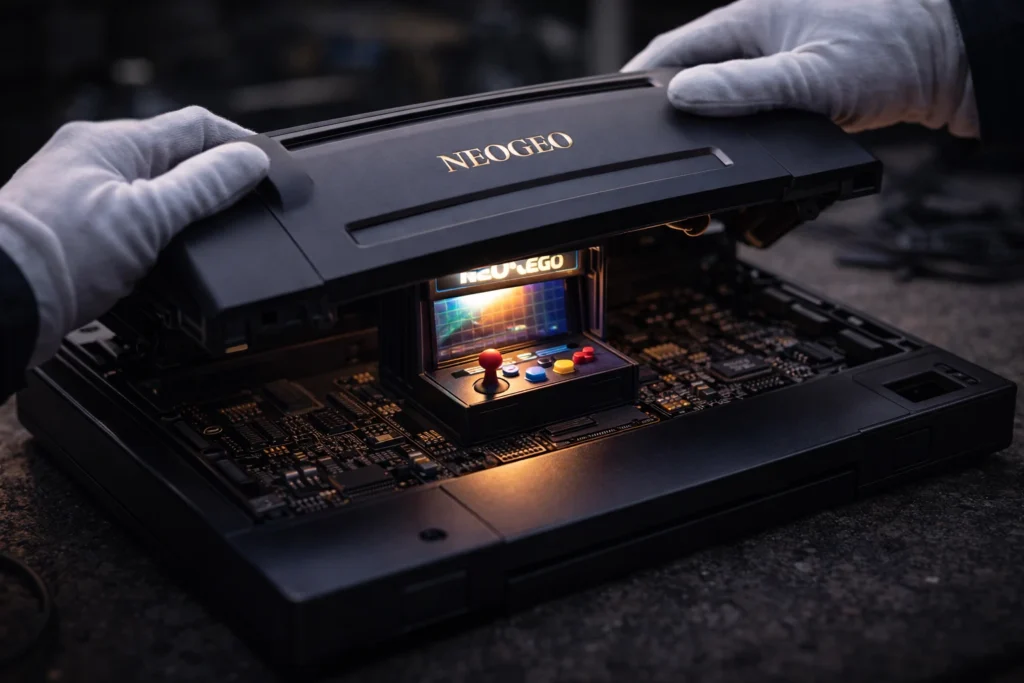
System architecture and a no-compromises vision
· The MVS system: maximum efficiency for arcades
Released in 1990, the Neo Geo MVS system revolutionized arcade halls. Its concept was simple yet brilliant:
- A single arcade cabinet.
- Multiple interchangeable games (from 1 up to 6 per cabinet).
- Game management via cartridges.
- Easy maintenance and upgrades for operators.
This reduced costs, saved space, and allowed games to be rotated without replacing the entire cabinet. For arcade operators, it was pure gold.
“One cabinet, six games… and every single one spectacular.”
· The AES system: arcade at home (if you could afford it)
At the same time, SNK launched the Neo Geo AES, identical in power to the MVS but aimed at a very exclusive home audience.
- AES cartridges were technically similar to MVS ones, but featured different shells and labels.
- Prices were extremely high: consoles costing over $600, and games priced at $200–300.
- The target audience: luxury hotels, VIP lounges, and high-end collectors.
While it was never a mass-market success, the AES forged a legend: the most powerful, expensive, and exclusive console in the world.
Neo Geo was not designed to compete with Super Nintendo or Mega Drive. It existed to make one thing clear: who ruled arcade graphics, sound, and gameplay.
· Revolutionary hardware
The Neo Geo architecture stood out for its clear focus: maximum graphical and audio capability, regardless of production cost or market volume.
Key system features:
- Main CPU: Motorola 68000 at 12 MHz (twice the speed of the Mega Drive).
- Coprocessor: Zilog Z80 for audio.
- Sound chip: Yamaha YM2610 (FM synthesis + PCM samples).
- Graphics: massive sprites, multi-layer scrolling, 65,536-color palette.
Thanks to this, Neo Geo games could deliver:
- Characters with fluid, highly detailed animations.
- Dynamic zoom effects in fighting games.
- Lively stages with multiple background planes.
The system also used high-capacity cartridges. The slogan “Max 330 Mega Pro-Gear Spec” proudly advertised game size—referring to 330 megabits (≈41 MB), a figure that would be surpassed years later.
“Most SNES games were 2 or 4 megabytes. Neo Geo launched with 46-megabit cartridges.”
· The first games
The initial Neo Geo lineup included some of the system’s most representative titles:
- NAM-1975: Futuristic third-person military shooter.
- Magician Lord: Fantasy-themed platformer.
- Baseball Stars Professional: SNK-style arcade sports.
- The Super Spy: First-person beat ’em up.
- Cyber-Lip: Side-scrolling action with heavy weapons.
These games already showcased the technical muscle and stylized design that would define the brand.
“They weren’t ports. They weren’t cut-down versions. It was the same arcade game… in your home.”
· Reception and global expansion
The MVS was an immediate success in Japan, Europe, and Latin America, where arcade operators valued its flexibility. The AES, by contrast, became more of a cult object than a mass-market console. In the United States, it was even sold through luxury retailers such as Neiman Marcus.
Despite its high price, the AES helped cement SNK’s image as a symbol of uncompromising quality and created a community of fans obsessed with arcade perfection.
· Why was it so special?
Neo Geo didn’t just offer raw power, it redefined style:
- System menus with a strong visual identity.
- Huge AES boxes and covers, closer to art books than game cases.
- Animated intros, memorable music, and an adult anime-inspired aesthetic that stood out.
“SNK did not rely on licensed properties, but on original creations, developing franchises that would go on to make history.”
3. The golden age of the Neo Geo system (1990–1996)
When SNK shone brighter than anyone else in arcades worldwide
If the launch of the Neo Geo MVS and AES was a revolution, the years that followed were its unquestioned peak. Between 1990 and 1996, SNK became synonymous with quality, style, and raw power. This was the era in which its greatest franchises were born, matured, and defined an entire generation. Arcade halls around the world vibrated with SNK’s striking animations, unforgettable music, and fierce combat.
Creative explosion and catalog consolidation
· Flagship games: the heart of the myth
During these years, SNK released some of the most iconic franchises in video game history. Each series had its own identity, unique visual style, and well-defined mechanics:
Fatal Fury (1991)
- SNK’s first major fighting game.
- Introduced a two-plane combat system with depth.
- Characters like Terry Bogard and Geese Howard became legends.
Art of Fighting (1992)
- Dynamic camera zoom: an unprecedented visual leap.
- Huge characters, highly detailed sprites, and early attempts at deeper storytelling.
- Spirit (ki) gauge, a precursor to EX-style moves.
Samurai Shodown (1993)
- Revolutionized fighting games with bladed weapons.
- Slower, more strategic and brutal combat, with feudal Japanese aesthetics.
- Introduced bleeding effects, subtle fatalities, and animated backgrounds with depth.
The King of Fighters (1994)
- A crossover of multiple SNK franchises.
- Three-fighter teams, strategy, and charisma.
- Year after year, a new KOF: it became the “FIFA” of arcade fighters but with art and technique.
Metal Slug (1996)
- Side-scrolling run-and-gun action with hand-drawn graphics, humor, and cartoonish violence.
- Legendary animations and obsessive attention to detail.
- One of the most reproduced, ported, and revered titles in the entire catalog.
· The SNK aesthetic: more than pixels
Neo Geo wasn’t just about brute force. It was also a visual identity.
- Gigantic sprites with hundreds of animation frames.
- Dynamic zoom in fights, multi-layer parallax scrolling.
- Elegant interfaces: carefully crafted menus, narrative intros, spectacular presentations.
- Memorable character design influenced by anime, cinema, and ’90s urban fashion.
“At SNK, a character wasn’t just a fighter. It was a story, a recognizable silhouette, a style.”
· Sound taken to the next level
Thanks to the YM2610 chip, Neo Geo delivered audio quality beyond anything else of its time. Soundtracks blended:
- Synthesized orchestral instrumentation.
- Digitized voice samples (still rare on 16-bit consoles).
- Instantly recognizable themes, from the flamenco guitar of Samurai Shodown to the funk riffs of KOF.
“Those opening chords, those digitized shouts you instantly knew: this is a Neo Geo.”
· Technical and gameplay innovations
SNK never stopped innovating. Throughout this era it introduced:
- Multi-game loading on MVS cabinets (up to 6 games per machine).
- Ever-larger cartridges, some exceeding 300 megabits.
- Save memory compatibility (Memory Card) between AES and MVS.
- Combos, throws, evasive moves, and distinct fighting styles by character and franchise.
Moreover, its arcade boards were robust and long-lasting. A well-maintained board can still run today with the same games.
· Global presence
During this period, SNK cemented its international footprint:
- In Latin America and Spain, MVS ruled the arcades.
- In the U.S., SNK began to challenge Capcom for fighting game dominance.
- In Japan, AES versions gained ground among collectors and high-level players.
Although it was never a mass-market company like Nintendo or Sega, SNK had something the others didn’t: absolute brand loyalty among its fans.
· A cult console, a collectible catalog
During these years, the AES catalog also grew. Despite its high price, it achieved cult status:
- Games with large clamshell boxes or even book-like formats.
- Colorful, detailed manuals.
- Massive cartridges with glossy labels.
- Limited editions and official reprints that today are worth thousands of dollars.
“An original boxed Metal Slug AES can exceed €20,000. It’s not a game, it’s a relic.”
· A turning point
By around 1996, the video game landscape was beginning to change. Sony’s PlayStation was redefining the industry with 3D graphics and FMV, and Nintendo 64 was on the way. No matter how beautiful they were, 2D graphics were starting to feel “old” when compared to the new standard.
However, SNK chose to resist through artistry, refining pixel art to perfection and doubling down on what it did best: solid, beautiful, demanding arcade games.
“Walking into an arcade in the ’90s and seeing a Neo Geo cabinet was a guarantee of spectacle.”
4. Decline and transformation (1996–2003)
From arcade glory to a fight for survival
The second half of the 1990s marked a turning point for the video game industry. The world was changing: 3D established itself as the new visual standard, home consoles gained ground, and the internet began to reshape how content was consumed and shared. In that context, SNK and the Neo Geo system, undisputed masters of 2D, found themselves at a harsh crossroads: adapt or disappear.
Market pressure and structural crisis
· Brutal competition
With the arrival of Sony PlayStation, Nintendo 64, and later Sega Dreamcast, video games filled up with polygons, cinematics, and CD-based storage. Against that backdrop, SNK continued to bet on sprites, pixels, and massive cartridges… something that many were beginning to see as “outdated.”
Games like Tekken, Virtua Fighter, Tomb Raider, and Final Fantasy VII changed the perception of what was considered “modern.”
SNK, without a new console or a competitive 3D system, remained faithful to its style, but lost visibility.
“While the world looked toward 3D, SNK clung to the perfection of 2D.”
· The weight of costs
The Neo Geo system, while powerful, was expensive to maintain and manufacture:
- AES and MVS cartridges kept growing in size and cost (over 700 megabits in some cases).
- High-quality 2D development required more and more time and artists, in an industry already chasing the “fast and spectacular” promise of 3D.
- The home market was limited: very few could afford AES prices.
Despite everything, SNK continued to release true masterpieces:
- The Last Blade (1997) and its sequel.
- King of Fighters ’97, ’98, ’99… up to 2003.
- Garou: Mark of the Wolves (1999) considered one of the greatest 2D fighting games ever made.
Commercially, however, it was not enough to sustain the company.
· Internal changes and restructuring
Under market pressure, SNK tried several strategies:
- Licensing its franchises to other platforms (PlayStation, Dreamcast).
- Publishing on CD-ROM and even GD-ROM (Dreamcast).
- Releasing simplified editions or ports on more accessible consoles.
- Creating a new 3D console with both arcade and home support: Hyper Neo Geo 64.
SNK also attempted to expand beyond Japan:
- Subsidiaries were established in Korea, the U.S., and other countries.
- MVS hardware was licensed so other companies could manufacture arcade cabinets.
But the decline was evident. SNK reported massive losses between 1999 and 2000, entered bankruptcy, and was forced to shut down.
· The closure of SNK Corporation (2001)
After years of effort, debt, and diluted licensing, SNK was absorbed by a Korean company called Aruze. During this process:
- Multiple projects were canceled.
- Many key talents left the company.
- Release quality became increasingly inconsistent.
In 2001, the company formally ceased operations.
“Many believed it was the end. But some employees were not willing to let the legacy die.”
· The rebirth: SNK Playmore
In an unexpected move, Eikichi Kawasaki, founder of SNK, bought back part of the intellectual property and founded a new company: Playmore, soon renamed SNK Playmore.
This “new SNK” regained control of franchises like Metal Slug, KOF, and Samurai Shodown, and began a slow process of recovery.
“It wasn’t the same SNK… but it wasn’t a copy either. It was an attempt to keep the fire alive.”
During this stage:
- New titles were developed for modern consoles (Metal Slug 3D, KOF: Maximum Impact).
- Classic compilations were released for PS2, Xbox, and later PSP.
- New collaborations emerged, such as SNK vs. Capcom, in partnership with Capcom.
· Neo Geo in its commercial twilight
Despite the fall, the original Neo Geo system remained active until 2004. That year saw the release of Samurai Shodown V Special, the last official game for MVS and AES.
A symbolic and bittersweet ending.
· The legacy lives on
Although the original SNK no longer existed, its legacy remained intact:
- The Neo Geo system became a cult object.
- Fans preserved and restored ROMs, boards, and cabinets.
- The retro community grew exponentially, generating tournaments, mods, translations, and more.
- In the 2010s, SNK would rise once again (which we’ll cover in the next chapter).
“Neo Geo didn’t age. It became cult.”
5. Legacy and rebirth (2003–Present)
When a legend refuses to disappear
After the closure of the original SNK in 2001 and the birth of SNK Playmore, the retro gaming world witnessed one of its most curious moments: a brand that died, yet never truly vanished. Through re-releases, compilations, new games, and an unbreakable community, the Neo Geo name found a new place in the hearts of players.
Preservation of the legacy and new forms of continuity
· SNK Playmore: the first steps of the return
Durante los años 2004–2010, SNK Playmore se enfocó en:
- Reclaiming its franchises: KOF, Metal Slug, Samurai Shodown…
- Publishing retro collections for consoles such as PlayStation 2, Xbox, and PSP.
- Releasing new entries in both 2D and 3D, with mixed reception:
- KOF: Maximum Impact (3D)
- Samurai Shodown Sen (a failed experiment)
- Metal Slug Anthology
These releases helped keep the names alive, although many fans perceived their quality as uneven.
· Compilations and re-releases
One of the engines of this rebirth was well-handled nostalgia. SNK released numerous collections:
- Neo Geo Online Collection (PS2 – Japan): updated versions with online play.
- Metal Slug Anthology (Wii, PSP, PS2): a complete collection of the saga.
- SNK Arcade Classics Vol. 1
- Samurai Shodown Anthology
- Digital editions on PSN, Xbox Live Arcade, and Steam.
These compilations brought the Neo Geo world, for the first time, to players who had never been able to afford an original AES.
· Neo Geo X (2012): the portable attempt
At the height of the retro console boom, SNK licensed the company Tommo to create the Neo Geo X, a portable console with an HDMI dock.
Features:
- 20 pre-installed games.
- AES-style replica controller.
- AES-inspired aesthetic dock.
- Expansion via additional game cards.
However, the product was quickly withdrawn from the market due to licensing disputes and quality issues. Today it is a curious collector’s item, though not fully representative of the original spirit.
· Neo Geo Mini (2018): nostalgia in miniature
To celebrate SNK’s 40th anniversary, the company released a mini arcade cabinet with a built-in screen.
Models and features:
- Multiple editions: international, Japanese, Samurai Shodown special, holiday editions.
- Between 40 and 48 pre-installed games depending on the version.
- HDMI output, USB controller compatibility.
- Chibi-style aesthetics (more “cute” than faithful).
While not universally praised, it was an important step in preserving and celebrating SNK’s history in an accessible way.
· SNK in the digital era
Since 2015, SNK has found new life on digital platforms:
- Arcade Archives (PS4, Switch, Xbox, PC): individual releases of classic games with modern options (save states, filters, challenges).
- SNK 40th Anniversary Collection: an excellent compilation with historical context, galleries, music, and extras.
- Limited physical re-releases by Limited Run Games, Pix’n Love, and others.
These initiatives didn’t just revive the games they also reconnected with collectors and fans of physical formats.
· Community and the homebrew scene
Meanwhile, the retro community has continued to grow. There are tournaments, forums, podcasts, YouTube channels, and events dedicated exclusively to:
- The King of Fighters ’98 or Garou: Mark of the Wolves.
- Cult titles like Windjammers or Shock Troopers.
- Development of new games for real MVS boards, such as:
- Gunlord (NGDevTeam)
- Kraut Buster
- Neo Drift Out 2020 (unofficial hack/remake)
There are also ROM hacks, translations, enhanced ports, and mods—some so polished they could pass for official releases.
“Neo Geo was never abandoned. It was adopted by its community.”
6. Epilogue: A philosophy still in play
From powerful pixels to a cult that never surrenders
SNK was not simply a company that made video games. It was a house of artisans, rebels, and designers who believed that games could be intense, beautiful, and fierce at the same time.
Unlike other brands, SNK did not try to conquer the family living room. It built a universe that spoke to passionate, demanding, loyal players…
A universe of hand-drawn sprites that never age, unforgettable music, pure gameplay with no filler, and communities that preserve, celebrate, and expand the legacy.
Today its name still lives on in tournaments, collections, forums, rediscoveries, and tributes. And although its form has changed, its core remains intact: the desire to offer an experience without compromise.
“Neo Geo wasn’t just a console. It was a way of life. And that doesn’t die easily.”