
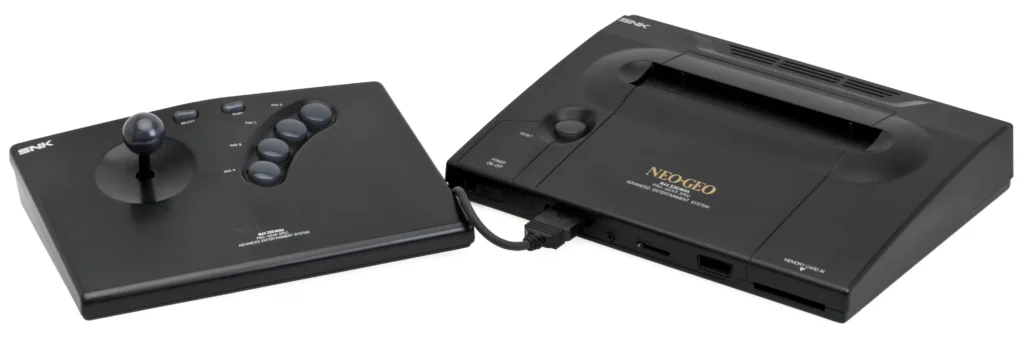
Image credit: Evan-Amos (Wikimedia Commons) – CC BY-SA 3.0 – Unmodified image.
1. Introduction and history
Released in 1990 by SNK Corporation, the Neo Geo AES was the home version of the powerful Neo Geo MVS arcade system. Originally conceived as a premium product for luxury hotels and entertainment venues, the console unexpectedly generated strong interest among home users. This led SNK to commercialize it as a high-end domestic console, retaining the exact same hardware as its arcade counterpart, something unprecedented in the industry at the time.
With a very high price for both the console and its games, the AES quickly became synonymous with luxury gaming. Its concept was clear: to deliver the exact arcade experience at home, without compromises or downgrades. While other consoles of the era relied on adapted or simplified arcade conversions, the Neo Geo AES offered pixel-perfect versions of its arcade titles.
The system became especially renowned for its fighting games such as Fatal Fury, Samurai Shodown, The King of Fighters, and Art of Fighting, as well as action titles like Metal Slug. Despite its limited commercial success due to high costs, its legacy as a premium console endures to this day, earning it a cult status among collectors and enthusiasts.
Neo Geo AES represents the culmination of SNK’s technological vision during the golden age of arcades. To better understand the business and creative context that gave rise to this console, you can explore the history of SNK.
2. Technical specifications
- CPU
The Neo Geo AES featured a dual-processor architecture, very common in arcade systems of its time:- Motorola 68000 at 12 MHz as the main CPU. It handled game logic, graphics processing, and core system operations. This processor was widely used in arcade hardware due to its efficiency and strong addressing capabilities.
- Zilog Z80 at 4 MHz as the sound coprocessor, responsible for controlling the audio hardware and managing sound-related tasks.
This architecture allowed demanding games to run smoothly thanks to task parallelization between both processors.
- GPU / Vídeo
The Neo Geo AES did not rely on a discrete GPU like modern consoles, but instead used a set of custom graphics chips integrated directly into the motherboard. These components handled sprites, scrolling, and background layers.- Support for up to 380 sprites simultaneously on screen, with scaling support.
- Sprite sizes of up to 16 × 512 pixels.
- Hardware-based horizontal and vertical scrolling.
- No polygonal or 3D rendering, focusing entirely on high-quality 2D graphics.
This made the Neo Geo AES one of the most powerful 2D gaming systems ever produced, with visuals comparable — and often identical — to contemporary arcade machines.
- Resolution
The console operated at a resolution standard for arcade hardware of the era:- 320×224 pixels in most games.
- 4:3 aspect ratio, designed for CRT displays.
This resolution offered an excellent balance between visual detail and performance, perfectly suited to fast-paced arcade-style gameplay.
- Color palette
- Total color palette: 65,536 colors (16-bit).
- Up to 4,096 colors on screen simultaneously (theoretical), with 3,840 effective colors.
The Neo Geo AES featured an exceptionally rich color palette for its time, allowing for far more detailed and vibrant visuals than most home consoles. Characters and environments benefited from smooth gradients, precise shading, and a wide range of colors, contributing to the system’s distinctive arcade-quality look.
- RAM / VRAM
- 64 KB of main RAM for game logic.
- 68 KB of VRAM dedicated to graphics and sprites.
- 84 KB total video memory (including palette data).
- 2 KB of internal battery-backed SRAM for save data.
These memory specifications were significantly higher than those of most contemporary consoles and were optimized to handle large amounts of graphic and audio data efficiently.
- Audio
The audio system was another standout feature of the Neo Geo AES:- Yamaha YM2610, a powerful FM synthesis chip with digital audio support
- 15 audio channels in total:
- 4 FM synthesis channels.
- 3 PSG channels (classic chip-style audio).
- 7 ADPCM sample channels (effects, voices, music).
- 1 direct digital channel.
- The system provided stereo audio output, with support for external speakers via RCA connectors or direct connection to arcade monitors.
Thanks to this hardware, the Neo Geo AES delivered rich digital music, complex sound effects, and high-quality voice samples, achieving an audio experience identical to that of its arcade counterpart.
- Physical media
The Neo Geo AES uses large proprietary ROM cartridges, technically equivalent to those of the arcade-based Neo Geo MVS system. These cartridges contain the full game data in ROM chips, allowing for instant loading with no waiting times.- Maximum theoretical size: 330 megabits (≈ 41.25 MB).
- The physical size of the cartridge is considerable: approximately 19 × 12.5 × 3.5 cm, with a weight of around 500 g.
- Each cartridge consists of two parallel boards (C-ROM and P/S-ROM) housed in a solid plastic shell.
Unlike most home consoles of the era—where arcade games were often downgraded—the AES versions were identical to their arcade counterparts, featuring the same graphics, sound, and gameplay. This was possible thanks to the shared hardware architecture between the AES and MVS systems.
It is important to note that although AES and MVS cartridges are technically similar, they are not physically compatible. Their pin layouts differ, and adapters or hardware modifications are required to use them interchangeably.
- Power supply
The console uses an external AC-to-DC power adapter, connected via a 5.5 mm × 2.1 mm barrel jack with center-negative polarity.
Several power supply models exist, classified by output voltage:- 5 V DC Power supplies (PRO-POW models)
- Input voltage (depending on region):
- PRO‑POW (Japan): 100 V AC (50/60 Hz)
- PRO‑POW‑UL (USA): 120 V AC (60 Hz)
- PRO‑POW‑PAL (Europe): 220‑240 V AC (50 Hz)
- Output: regulated 5 V DC, 3 A, center-negative polarity.
- Input voltage (depending on region):
- 9–11 V DC Power supplies (NEO-POW3 / PRO-POW-E)
- Output: 9–11 V DC (unregulated), up to 1 A, also center-negative.
- NEO‑POW3 (Japan): 100 V AC → output 10 V 1 A or 11 V 700 mA.
- PRO‑POW‑E (EU/US): admite 110–240 V AC, output 10 V 1 A.
- Output: 9–11 V DC (unregulated), up to 1 A, also center-negative.
- 5 V DC Power supplies (PRO-POW models)
These power supplies feed an internal regulation circuit (based on an LM2576 regulator and inductor) that converts the voltage to stable 5 V DC for the system.
- Ports and connectivity
The front and rear of the console include the following connectors:- 2 × DB15 controller ports: SNK standard connectors, offering direct arcade-style input compatibility.
- AV video output (8-pin DIN): Supports both RGB and composite video, depending on the cable used (composite AV cable or RGB SCART cable).
- Mono audio output (via DIN-8): The AV multi-out connector delivers a mono audio signal, mixing the left and right channels.
- Stereo audio output (front headphone jack): 3.5 mm jack providing true stereo audio with separated left and right channels.
- Memory Card expansion port: 68-pin JEIDA V3 connector (2 × 34 pins), compatible with original SNK memory cards and third-party alternatives.
3. Models and revisions
The Neo Geo AES did not feature a wide range of external model variations, but several internal motherboard revisions do exist:
- NGH-1X (Japan):The earliest models released in Japan, featuring the Japanese BIOS. Some units are known for having superior video output quality, especially in RGB. These models are often preferred by collectors and modders due to their originality, build quality, and ease of modification.
- NGH-9X (USA): Models intended for the North American market. These units included a BIOS with censorship enabled in certain games (blood effects, voice lines, etc.). Physically identical to the Japanese versions, they differ mainly in regional settings, BIOS behavior, and minor video compatibility aspects.
- NEO-AEC (Europe / PAL): Although SNK never officially distributed the AES in Europe through a dedicated subsidiary, it did manufacture units specifically configured for the European market. These consoles are known as PAL models and were sold through European distributors.
They feature PAL 50 Hz video output, 220–240 V power compatibility, and in some cases additional RF shielding. They can be identified by the NEO-AEC motherboard, and many units include a factory-installed PAL/NTSC selection jumper. These models are relatively uncommon and highly valued among European collectors.
In general, all AES consoles share the same external design. The internal differences lie in the type of video output, the BIOS region (Japan, USA, PAL), the power supply configuration, and minor variations in the video circuitry.
4. Colors and retail bundles
- Black: Standard color used across all Neo Geo AES models.
- Retail bundles
- Neo Geo AES “Gold System”: The console was marketed as the “Gold System” with an initial price of $649.99 USD, and included two joysticks, one game (initially NAM-1975 or Baseball Stars Professional, later Magician Lord and Fatal Fury), and a memory card.
- Neo Geo AES “Silver System”: Unlike the Gold version, the Silver System was introduced as a more affordable option, priced at $399.99 USD.
While the console hardware itself was identical across all versions, the main differences of the Silver package were that it included only one joystick and did not include a game or a memory card.
5. Featured peripherals
5.1. Official
- Neo Geo AES Stick Controller
The standard controller for the Neo Geo AES was, quite literally, an arcade control panel brought into the home.- Solid and bulky construction: Its robust casing and large size faithfully replicate the feel of an arcade control panel.
- Joystick with square restrictor: The internal mechanism uses microswitches and a square gate, providing clear tactile feedback and high precision. This design is widely praised for its accuracy, especially in fighting games.
- Large inline buttons (A, B, C, D): Arranged in a slightly curved layout, with convex tops. The buttons match the controller’s color and closely resemble those found on arcade cabinets.
- Proprietary DB15 connector: The same connector used by Neo Geo arcade cabinets and the Neo Geo CD, ensuring full compatibility across SNK systems.
Widely regarded as one of the best console arcade sticks ever made, thanks to its durability, precision, and authentic arcade feel.
- Neo Geo AES Stick Controller Pro
The pro controller was a refined evolution of the original arcade-style stick:- Improved ergonomics and solid weight: Retains the large form factor, but with smoother, more rounded lines for improved comfort.
- Enhanced joystick: Preserves the tactile feel of the original but offers greater precision.
- SNK-style buttons: Noticeable click with shorter travel. The button layout was changed to a more horizontal arrangement. The top surface is now flat. The A and B buttons are red, while the C and D buttons are gray.
- Same DB15 connector: Fully compatible with AES and MVS systems, just like the original stick.
- Neo Geo CD Controller (or “CD Pad”)
With the release of the Neo Geo CD in 1994, SNK introduced a more compact and accessible controller:- Rounded and lightweight design
- Disc-style directional pad (“clicky disc”)
- Softer, more ergonomic buttons
- Easier to use than the heavy AES arcade stick
- Neo Geo Memory Card
The Neo Geo Memory Card was one of the most innovative features of the system. It uses a JEIDA V3 68-pin connector and contains a 2 KB SRAM chip powered by an internal battery, allowing storage of up to 20 save files (or up to 27 entries, depending on the game).
The card connects to the front slot of the AES console and can also be used in compatible MVS arcade cabinets, allowing players to save progress at home and continue their game in an arcade, an unprecedented feature in the early 1990s.- Official SNK Memory Card, identified as NEO-IC8, featuring SRAM storage with a lithium battery for data retention.
- Compatible with both the AES console and MVS arcade systems equipped with a memory card slot.
- Used only in games that support the save system (not all titles include this functionality).
- Known external variants
- Standard model: Black casing, white logo, and yellow lettering.
- “Marble” model: Speckled gray casing, highly valued by collectors.
- Internal board revisions
- C10075-X2-2: First production revision manufactured by SNK.
- EZ866: Later revision with minor component layout differences, but identical functionality.
- Both versions use the same 2 KB memory chip and are fully compatible and interchangeable.
Thanks to its compatibility between home console and arcade systems, the Neo Geo Memory Card was a precursor to concepts later adopted by systems such as the PlayStation and Dreamcast.
5.2. Unofficial accessories
Over time, a wide range of unofficial accessories have been created to expand the functionality of the Neo Geo AES while preserving its original design and compatibility. Although not produced by SNK, many of these devices have become essential for getting the most out of the system.
- MVS–AES adapters
MVS–AES adapters allow arcade-format MVS cartridges to be used on the home AES console. Since MVS cartridges are far more common and significantly cheaper than original AES cartridges, these adapters open the door to a much larger game library without the high cost associated with AES collecting.- The adapter connects directly to the AES cartridge slot, acting as an interface between the AES and MVS formats.
- Some models include voltage converters or correction chips to improve compatibility.
- Not all MVS games work perfectly on every adapter, especially titles with additional hardware or protection mechanisms.
- Build quality varies widely: from simple adapter boards to more advanced designs featuring 3D-printed shells, multi-slot support, or improved video output.
These adapters are highly valued by users who want to enjoy the arcade catalog at home without paying the high prices associated with original AES cartridges.
- JGO Memory Card
The JGO Memory Card is a modern save device compatible with both Neo Geo AES and MVS systems. It offers several advantages over the original SNK memory card:- Uses 32 KB of SRAM, divided into two 16 KB banks.
- No battery required, data is retained without power thanks to modern memory technology.
- Fully compatible with all games that support the save system.
- Provides greater capacity and long-term reliability.
Although it is not an official SNK product, it is widely accepted within the community and has become a reliable and practical solution for users who regularly play on real hardware or perform system modifications.
- Universe BIOS Memory Cards
Some manufacturers have integrated UniBIOS directly into external memory cards. These “UniBIOS Memory Cards” allow users to change region, language, enable cheats, or access hidden modes without modifying or opening the console.- They function as standard memory cards, but with additional capacity to store the UniBIOS.
- Some versions include switches or hidden buttons to access advanced features.
- Ideal for users who want extended functionality without performing permanent hardware modifications.
Compatibility may vary depending on the console revision, and reliability depends on the quality of the manufacturer.
- Super converter (Brook Neo Geo Controller Adapter)
The Brook Super Converter is an adapter that allows modern USB controllers, such as PlayStation or Xbox gamepads, or contemporary arcade sticks, to be used on the Neo Geo AES. It is especially useful for players who prefer Sanwa or Seimitsu-based sticks, or who want to use wireless controllers.- Converts USB input to Neo Geo DB15 protocol.
- Requires no external power supply.
- Some versions offer ultra-low input lag, ideal for fighting games.
- Can also be used with other DB15-compatible systems.
This adapter provides a modern and practical way to enjoy the Neo Geo AES using ergonomic or customized controllers while maintaining full compatibility with the system.
6. Representative games and complete game list
- Magician Lord.
- Fatal Fury.
- Samurai Shodown.
- The King of Fighters ’94.
- Metal Slug.
- Garou: Mark of the Wolves.
- Complete list of official AES games.
7. Modifications and enhancements
This section will be gradually expanded with step-by-step documented modifications, hardware testing, and projects related to the Neo Geo AES.
Guiamodconsolas prioritizes publishing only tested and properly documented content, so this section will continue to grow as projects are completed and verified.
8. Curiosities
- It was the most expensive home console on the market throughout its commercial life.
- The price of individual cartridges could exceed $200–$300 USD at the time of release.
- The system remained active for over a decade, with releases continuing until 2004, making it one of the longest-lived consoles without major hardware revisions.
- The name “Neo Geo” comes from the Greek term meaning “new world”, reflecting SNK’s technological ambition.
- Some cartridges, such as Kizuna Encounter (European version), have sold at auction for five-figure sums.
- The MVS and AES systems share so much hardware that parts can often be exchanged for repairs or modifications.
- Metal Slug was originally developed for the Neo Geo and remains one of the most ported and celebrated arcade games in history.