
The history of Atari is the story of an origin. It is the first heartbeat of an industry that did not yet know what it would become. From Californian laboratories to arcades around the world, Atari defined the language of modern video games. It invented, took risks, fell, and rose again. Its legacy remains present in every pixel. This is its story.
1. The origins of Atari (1972–1977)
From a Californian garage to the birth of a global industry
In 1972, while digital entertainment was only beginning to take shape, two electronic engineers, Nolan Bushnell and Ted Dabney, founded a company in California that would forever change the history of video games: Atari, Inc.
The name “Atari” comes from the Japanese board game Go, where the term means something like “warning” or “imminent threat” a curious parallel to what would eventually happen: Atari became a warning to the entire industry… that video games were here to stay.
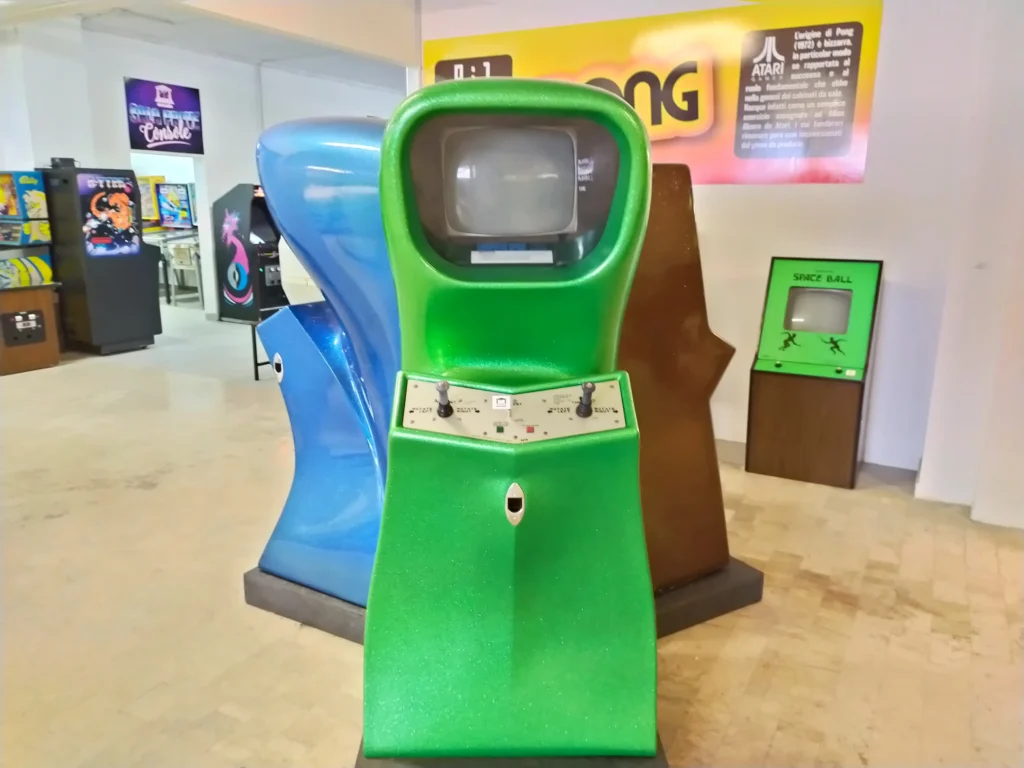
Image credit: Marica Massaro (Wikimedia Commons) – CC BY-SA 4.0 – Unmodified image.
The pioneers who ignited the first spark
· The first steps: from engineers to pioneers
Before Atari, Bushnell and Dabney were already experimenting with electronic circuits applied to entertainment. In 1971, they designed Computer Space, the first commercial arcade video game although its complexity kept it from becoming a mass success. Shortly afterward, they founded Atari with a much more accessible idea: a simplified table-tennis video game. Thus, Pong was born in 1972.
The first prototype was installed in a local bar, and within days it stopped working. The owner thought it had broken, but in reality, the coin box was so full it could no longer close.
“It wasn’t an experiment. It was the beginning of a new industry.”
· Atari multiplies: games, circuits, and talent
After the explosive success of Pong, Atari rapidly expanded its catalogue and production:
- They created their own variants (Pong Doubles, Super Pong) and clones.
- They founded a second company (Kee Games) to bypass exclusivity contracts with operators.
- They established manufacturing, distribution, and technical support networks.
Between 1973 and 1976, Atari was not just making video games — it was building a culture. Young engineers worked in sandals, drank beer during office hours, and redesigned electronic entertainment from the inside out.
The company grew to hundreds of employees. Among them was Steve Jobs, who, together with Steve Wozniak, designed the arcade game Breakout in 1976.
“Atari’s philosophy was simple: if something didn’t exist, invent it.”
2. The conquest of the home (1977–1982)
From arcades to the living room
In 1977, Atari made a colossal leap by launching its first home console: the Atari VCS (Video Computer System), later known as the Atari 2600. Its premise was revolutionary: interchangeable cartridges, a joystick controller, color graphics, and sound, all in a format accessible for home use.
Atari VCS and the Warner era
· The arrival of Warner Communications
In 1976, before the launch of the VCS, Atari was acquired by Warner Communications for 28 million dollars. This operation injected capital, enabled mass production, and professionalized the brand… but it also marked the beginning of internal tensions.
Bushnell, increasingly pushed aside from management, left the company in 1978.
· The first modular video game system
Until then, home consoles offered a single game or only minor variations. The Atari VCS changed the rules:
- Independent ROM cartridges.
- Support for multiple genres, from tennis to space adventures.
- Generic controls (joystick + button) usable across all titles.
In a way, it was the MVS of its time: a base platform with modular software, ready to grow.
· Iconic hardware: the Atari 2600 under the hood
The heart of the Atari VCS/2600 was extremely modest, even by the standards of its era. The system was built around the MOS 6507 chip, a reduced version of the popular 6502, accompanied by just 128 bytes of RAM and a graphics chip known as the TIA (Television Interface Adaptor).
The magic lay in how developers pushed these limitations:
- Graphics generated “on the fly” by the CPU, with no framebuffer.
- No true sprites: objects were bit patterns controlled in real time.
- Simple but functional mono sound, integrated into the TIA.
- Cartridges initially 2 KB, later expanded to 4, 8, and 16 KB using bank-switching techniques.
The result was a console that was extremely cheap to manufacture, but demanded true craftsmanship from its programmers. That relationship between limited hardware and overflowing talent is precisely what defined its golden age.
“Programming the Atari 2600 was like painting a mural through a keyhole.”
· Iconic games of the era
The Atari 2600 catalogue quickly grew, with several titles now considered historic:
- Adventure (1979): the first game with connected “screens” and a hidden Easter egg.
- Space Invaders (1980): the Taito arcade conversion that skyrocketed console sales.
- Pitfall! (1982): a precursor of modern platform games.
By 1982, the Atari 2600 was already a global success, with tens of millions of units sold and thousands of independent developers interested in the format.
“Atari became a factory of creativity… and a money-printing machine.”
3. The golden age of Atari (1979–1982)
When Atari was synonymous with video games
Between 1978 and 1982, Atari reached the peak of its global influence. It wasn’t just selling consoles and games: it was shaping a new form of entertainment. Its logo was recognized worldwide, its products entered millions of homes, and its culture permeated everything from television advertising to toy store shelves.
Cultural apogee and absolute dominance
· Atari 2600: unstoppable commercial success
With more than 25 million units sold during its lifetime, the Atari 2600 became the most popular console in the world. Cartridges filled store displays, and marketing campaigns positioned video games as part of everyday life.
“Now everyone can have their own arcade… in the living room.”
· A brand turned cultural phenomenon
Atari was not just hardware. It was clothing, backpacks, stickers, posters, and comics. It had constant presence in magazines, TV shows, and youth programs. In the United States, its name became as recognizable as Disney or Coca-Cola.
· An industry growing around it
The popularity of the Atari 2600 attracted dozens of external developers and emerging studios. Companies like Activision and Imagic began releasing their own cartridges for the console without going through Atari, creating the first major conflict over licensing ownership and editorial control in video games.
· Arcade and home: double dominance
Atari also thrived in arcades, with machines such as:
- Asteroids (1979): one of the first space shooters with realistic physics.
- Centipede (1981): fast-paced action with a surreal aesthetic.
- Tempest (1981): revolutionary for its simulated 3D perspective.
Many of these titles were later adapted to the home console, creating synergy between arcade and household gaming long before this model became standard.
· A success with hidden cracks
Despite the boom, internal problems were already emerging:
- Conflicts between creative leadership and Warner executives.
- Lack of credit and royalties for programmers.
- Mass production of games without quality control.
All of this prepared the ground for a collapse that still seemed far away.
“Atari was a rocket at full speed… but with a fuselage growing hotter by the day.”
4. The fall of the colossus (1982–1984)
When the industry grew too big… and everything collapsed
By the early 1980s, Atari had become synonymous with video games worldwide. But the company’s rapid growth, market saturation, and a series of strategic mistakes would culminate in one of the greatest collapses in technological history: the video game crash of 1983.
The ’83 crash and the fragmentation of Atari
· Success that became unsustainable
The Atari 2600 was already a mass-market console. Sales counted in the tens of millions, and the market was flooded with cartridges — both official and third-party. But quality control was practically nonexistent, and mediocre titles multiplied.
In addition, pressure to maintain sales momentum led to rushed decisions:
- Overproduction of licensed games like Pac-Man (1982), which disappointed due to its poor adaptation
- A multimillion-dollar contract to release E.T. the Extra-Terrestrial (1982), developed in just five weeks
- Millions of unsold or returned copies, stored… or buried in the New Mexico desert
“The E.T. game was not the only cause of the crash, but it became its most iconic symbol.”
· A saturated and uncontrolled market
By mid-1982, more than 300 companies were releasing video games in the United States. From improvised studios to traditional toy manufacturers, everyone wanted a piece of the pie. Quality plummeted, consumer confidence collapsed… and retailers began returning stock in massive quantities.
Atari went from a gold-printing machine to a source of heavy losses.
· Internal rupture and loss of value
Warner, alarmed by collapsing profits, demanded cuts, layoffs, and a change of direction. Many veteran employees left. Among them were the founders of Activision, the first third-party developer in history, born precisely from internal frustration with Atari.
In 1983, Atari recorded losses of more than 500 million dollars.
· The division of the company
In 1984, Warner decided to split and sell Atari:
- The home division (consoles and computers) was sold to Jack Tramiel, founder of Commodore. This became Atari Corporation.
- The arcade division, more profitable and stable, remained under Warner as Atari Games.
For years, both companies operated under the same name… but on separate paths.
“In just twelve years, Atari was born, conquered the world… and collapsed under its own weight.”
5. Two paths, one name (1984–1996)
Home reconstruction and arcade resistance after the collapse
In 1984, the Atari brand ceased to be a single entity. After Warner’s financial collapse, the home division was sold to Jack Tramiel, while the arcade unit remained under Warner with a different direction and philosophy. For more than a decade, two different Ataris coexisted, both trying to survive in their own way.
5.1. Atari Corporation: Home reconstruction under Jack Tramiel
· The Commodore legacy
After leaving Commodore, Jack Tramiel purchased Atari’s home division and reorganized the company around his business vision: low costs, aggressive margins, and affordable hardware. His management style stood in stark contrast to the Bushnell era.
· Atari ST computers
Released in 1985, the Atari ST line consisted of 16-bit personal computers that competed directly with the Amiga 500. They stood out for their competitive price and for being the first computers to include a graphical interface and built-in MIDI ports as standard, making them popular in the music industry. They were also widely used in home, educational, and semi-professional environments.
· Atari 5200
Designed as the natural successor to the Atari 2600, the 5200 SuperSystem offered significantly improved graphics and sound, based on the Atari 8-bit computer architecture. However, it arrived in a saturated market, had a limited catalogue, and its controller (with a non-centering analog joystick and numeric keypad) was heavily criticized for being imprecise and fragile. It was also incompatible with Atari 2600 games, confusing consumers. It became a commercial failure that further worsened the company’s situation on the eve of the 1983 crash.
“Too new for traditional players, and too limited for the future.”
· Atari 7800
Originally presented in 1984 but released in 1986, it became the official successor to the 2600. Although backward compatible and technically superior to the NES, it arrived too late and with little third-party support. Even so, it sold better than the 5200. Its MARIA graphics chip enabled improved sprites and scrolling, but a cost-driven design limited its appeal against Nintendo and Sega’s consoles.
· Atari Lynx
Launched in 1989, the Lynx was the first handheld console with a color backlit screen and image rotation capability. Originally developed by Epyx and later acquired by Atari, it featured hardware far superior to the Game Boy, but poor battery life and high price worked against it. Its support for local multiplayer and advanced visual effects was innovative, yet it never achieved a competitive catalogue.
· Atari Jaguar
In 1993, Atari launched its last major attempt: a console marketed as “the first 64-bit system.” Its architecture, based on multiple proprietary chips, proved difficult to program, and its catalogue remained limited. Despite notable titles such as Tempest 2000 and Alien vs. Predator, it failed to compete against the Sega Saturn and PlayStation. A lack of development tools, inconsistent marketing, and weak third-party support sealed its fate. It became the final nail in the coffin for Atari as a console manufacturer.
“Tramiel tried to rebuild Atari through hardware, but never regained the player’s trust.”
· The end of an era
By the mid-1990s, Atari Corporation was in full decline. The failed Jaguar gamble, unprofitable divisions, and growing competition left the company with no room to maneuver. The Tramiel family, which had led Atari since 1984, gradually withdrew from the business.
In 1996, Atari merged with storage company JT Storage, a move driven more by financial survival than by genuine technological strategy. This merger marked the official end of Atari as a home-hardware manufacturer. Its name, once synonymous with video games, became a floating brand with no active products and no clear direction. Thus ended one of the most influential, and turbulent, trajectories in video game history.
“Atari did not fall in a single blow, but through accumulated wear: late decisions, hardware without software, and a market that no longer waited for it.”
5.2. Atari Games: The arcade legacy and technical innovation
· Staying under Warner and the birth of Tengen
The arcade branch became Atari Games, operating independently from Atari Corporation. In 1987, they created Tengen, a subsidiary label to publish home games on the NES and other systems. Their legal confrontation with Nintendo over licensing became a historic battle in the industry.
· Paperboy (1985)
This arcade game placed players in the role of a newspaper delivery boy on a bicycle, navigating a suburban neighborhood filled with obstacles, hostile residents, and absurd situations. Its physical handlebar controller offered a unique experience, adding a layer of tactile realism that anticipated future simulation games.
The isometric design and humorous visual style set trends, while its blend of action, skill, and route management made it a distinctive proposal for its time. It was widely exported and adapted to multiple home systems.
· Gauntlet (1985)
One of the first cooperative multiplayer games for up to four players simultaneously, featuring a top-down view and hack & slash gameplay. Each player assumed a classic fantasy role (warrior, valkyrie, wizard, elf), encouraging teamwork and strategic use of abilities.
Gauntlet also introduced the concept of time-limited health, increasing game pace — and the need to insert more coins. Its success was overwhelming, leading to multiple sequels and countless clones.
“Gauntlet was not just a game, it was a social experience.”
· Hard Drivin’ (1989)
Revolutionary for its real-time 3D polygon graphics, something extremely rare outside military or academic environments in the 1980s. It was one of the first driving simulators to offer an enclosed cockpit with steering wheel, clutch, and gear shifting, alongside a realistic sense of physics including collisions.
Its 3D environments, featuring ramps, loops, and jumps, offered a blend of simulation and pure arcade. Though its difficulty made it less popular with casual audiences, it laid the foundation for modern driving simulators.
· Primal Rage (1994)
At the height of the fighting game boom sparked by Mortal Kombat and Street Fighter II, Atari Games delivered an original concept: animal gods in the form of dinosaurs and mythological beasts, animated through digitized stop-motion techniques.
It stood out for its post-apocalyptic setting, interactive stages, and cartoonish violence. Controversial for some animations and fatalities, it nonetheless achieved strong arcade popularity and received home versions on nearly every platform of the era.
· A different vision of video games
Unlike Atari Corporation, which pursued profitability through hardware, Atari Games focused on technical innovation, experimentation, and the creation of unique arcade experiences. Their titles were less predictable, more daring, and many anticipated concepts that other companies would later adopt.
· The end of Atari Games
During the 1990s, Atari Games was sold by Warner to WMS Industries (owner of Midway), and later passed to Hasbro Interactive, closing a key chapter in arcade video game history. Despite continuous ownership changes, the studio maintained activity until its final dissolution in the early 2000s. From that point on, the name “Atari Games” disappeared, and its legacy became scattered across licenses, corporate mergers, and brand acquisitions.
The “Atari” brand itself would remain fragmented… until its surprising reunification years later.
“While one Atari looked to the past seeking stability, the other kept inventing the future… in the arcades.”
6. The Immortal Brand (1996–Present)
When the name weighs more than the product
After the dissolution of its historic divisions, many considered Atari dead. Yet its name never fully disappeared. In the years that followed, different companies bought, sold, and reshaped what remained of Atari, aware that the brand still held symbolic, cultural, and commercial value.
Reunification, legacy, and rebirth
· Infogrames: reviving Atari from Europe
In 2001, French company Infogrames Entertainment acquired the Atari brand rights after purchasing Hasbro Interactive, and officially adopted the Atari name. With this move, Atari was reborn as a global publisher focused on licenses, catalog titles, and digital releases.
During this period, the company reissued classic titles through compilations (Atari Anthology, Flashback Classics) and published new games under well-known licenses (RollerCoaster Tycoon, Test Drive), but without a clearly defined identity.
“Atari went from visionary hardware company to a brand that evoked nostalgia.”
· Atari as a licensing company
In the 2010s, Atari restructured itself as an intellectual property firm, aiming to commercially exploit its legacy. The brand was licensed for clothing, mobile games, NFTs, virtual casinos, and retro-themed products. This model proved profitable, but disconnected from the company’s original essence.
Many long-time fans criticized Atari for becoming a “corporate zombie,” exploiting its name without developing innovative products.
· Atari VCS (2021): between retro and modernity
In an attempt to return to hardware, Atari announced a new hybrid console: the Atari VCS, launched in 2021 after multiple delays and crowdfunding campaigns. Aesthetically inspired by the 2600, it combined retro console functions, PC features, and multimedia center capabilities. However, its catalogue was small and its impact very limited.
The product showed that the Atari name still sparks interest, but also that reclaiming a place in the modern industry requires more than nostalgia.
· Present and future of the brand
Today, Atari SA (official name since 2009) operates as a small but active company focused on retro re-releases, low-cost digital games, and collaborations with license partners. In 2023, it acquired Nightdive Studios, creators of acclaimed remasters such as System Shock, opening the door to more ambitious initiatives.
The brand remains alive, no longer as a technological pioneer, but as the symbol of an industry’s origin.
“Atari no longer leads the way, but its shadow still stretches across everything that came after.”
7. Epilogue: The spark that ignited the game
From pioneering silicon to the eternal memory of a newborn industry
There was a time when a square ball and two bars were enough to imagine a match. A time when video games were not yet an industry or a market, but pure experiment, a spark, an illusion.
And at the center of it all, there was a name: Atari.
Atari was the first word in the language of video games. The first heartbeat of a culture that did not yet know it existed. It was the hum of an arcade cabinet in the darkness, the flicker of a CRT television, the click of a one-button joystick.
With time, the language changed, the rhythm changed, the players changed. And Atari, like many pioneers, faded through mergers, failures, and reinventions. But it never disappeared completely.
Today, its name no longer creates consoles or revolutionizes genres, but it still shines in the memory of those who witnessed the beginning of it all. In worn box art, in eternal pixels, in shared nostalgia.
“Because in every game that begins, there is still a little of Atari pressing Start.”