The history of SEGA is a creative roller coaster that defies the conventional cycles of success and failure. From its origins linked to music and entertainment for soldiers to becoming one of the most iconic giants in the video game industry, SEGA has been synonymous with risk, style, and personality.
It was a company that not only managed to compete with titans like Nintendo, but also set the pace with bold ideas, memorable consoles, and a catalog that still resonates in the collective memory. Few brands can claim to have created icons such as Sonic, Virtua Fighter, or Shenmue, to have pioneered 3D graphics, online gaming, or emotionally driven storytelling in video games.
But it is also a story of setbacks. Of controversial decisions, internal divisions, and consoles that were ahead of their time but failed to find their audience. SEGA reinvented itself more than once: from hardware to software, from direct rival to collaborator with its former competitors. It never disappeared it simply changed shape.
Because to talk about SEGA is to talk about energy, color, noise, and speed. About unrestrained innovation and a passion for play that, despite every crisis, never faded.
This is the history of SEGA. A company that dreamed of being a leader and ultimately became a legend.
1. From arcades to the living room (1940–1985)
From entertainment machines to a pioneer of home gaming
Before SEGA conquered the screens of millions of homes with memorable consoles and iconic characters, its story began on the fringes of the mechanical entertainment world. A story shaped by wars, oceans, and radical transformations, ultimately leading SEGA to establish itself as one of the great pioneers of the video game industry.
Early steps and initial consolidation
· Origins between war and entertainment
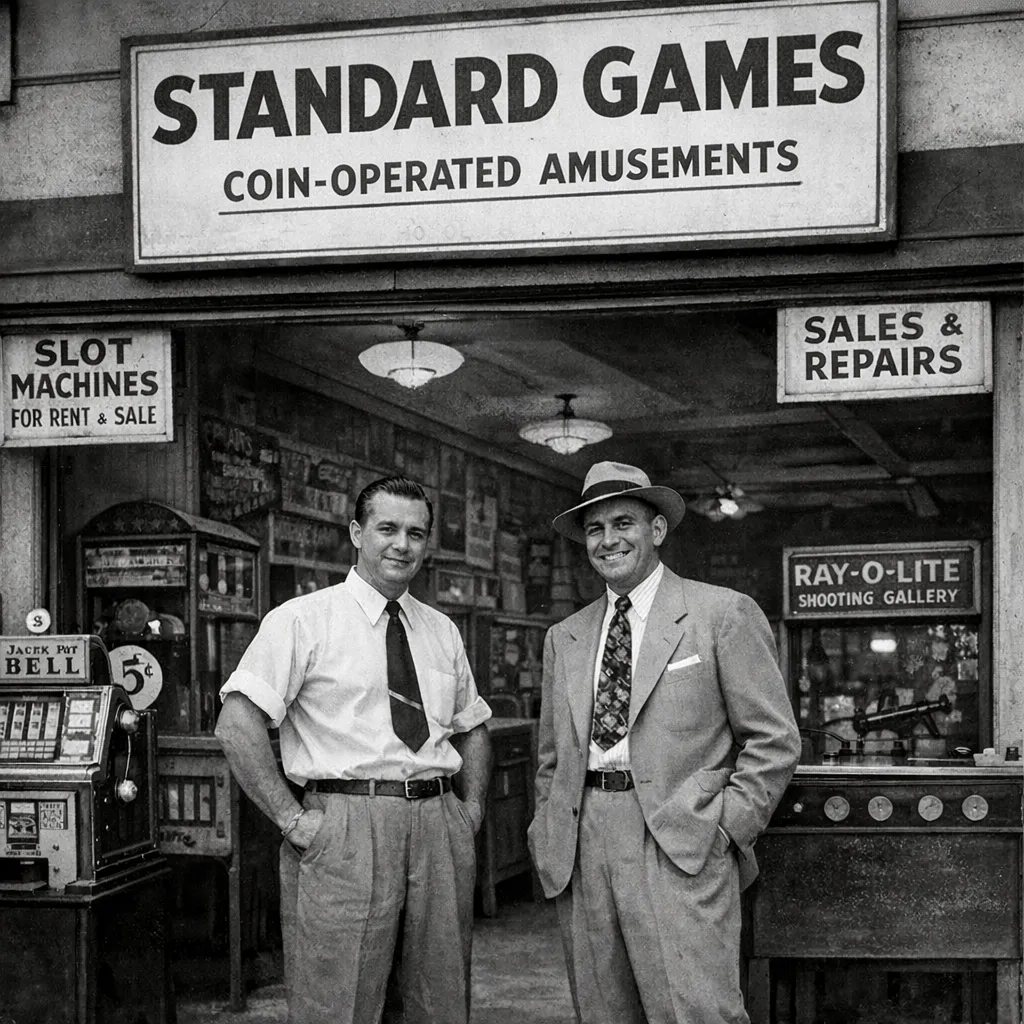
SEGA was born from a transoceanic merger of companies. It all began in 1940, when Martin Bromley and Richard Stewart founded Standard Games in Hawaii, a company created to supply coin-operated amusement machines to U.S. military bases in the Pacific. After World War II, operations moved to Japan, where Service Games was founded in 1951 with the same purpose.
In 1960, Service Games merged with Rosen Enterprises, a company led by David Rosen that focused on importing photographic and entertainment machines. This merger officially gave rise to SEGA Enterprises Ltd., an abbreviation of Service Games. From that point on, the company focused on the production and distribution of arcade machines.
· First steps in arcades
Throughout the 1960s and early 1970s, SEGA specialized in electromechanical games such as Periscope (1966), a naval simulation that achieved massive international success. As technology evolved, SEGA embraced electronic video games, making the leap with titles like Pong-Tron and Moto-Cross.
In 1979, SEGA released Head On, an early precursor to the chase game genre. Shortly after, titles such as Zaxxon (1982) appeared, featuring advanced isometric graphics for their time. SEGA began to stand out for its innovative technical approach and bold, unconventional game design.
· First home console attempts: SG-1000
In 1983, SEGA entered the home console market for the first time with the SG-1000, released on the very same day as Nintendo’s Famicom. Although it was a pioneering effort, the SG-1000 was quickly overshadowed in both popularity and software library. Nevertheless, it served as an important foundation for future developments, both in hardware design and internal company structure.
That same year, SEGA was acquired by the Japanese conglomerate CSK Holdings, a move that allowed the company to reorganize its operations and pursue console development as a more serious strategic objective.
· Heading toward the great battle
With new leadership and growing experience in both arcades and home hardware, SEGA began preparing to launch a more competitive console. The following decade would mark its true assault on the living room.
“Before Sonic ever ran, SEGA had already spent years racing through the dark corridors of arcades.”
2. The blue era (1986–1991)
Mascots, consoles, and the rise of a distinctive style
After its initial consolidation in the video game industry, SEGA made a strategic shift that would turn it into one of the defining forces of the late 1980s and early 1990s. The company committed to consoles with a more aggressive profile, visually striking and aimed at a younger audience seeking something more challenging. In contrast to Nintendo’s more family-friendly tone, SEGA forged its identity around a rebellious, modern, and technology-driven image. Thus, one of the most legendary rivalries in video game history was born.
Home expansion and brand consolidation
· Master System and the 8-bit showdown
In 1985, SEGA released the SG-1000 Mark III, which would soon be known internationally as the Master System. This 8-bit console was designed to compete directly with the NES, offering superior technical specifications: a broader color palette and more detailed sprites.
While its performance in Japan and the United States was limited, it achieved notable success in regions such as Europe, Brazil, and Oceania, where it even outperformed Nintendo in certain markets. SEGA delegated distribution to companies such as Tonka in the U.S. and Tec Toy in Brazil, significantly extending the console’s lifespan for many years.
· The birth of Sonic and the symbol of a generation
By the late 1980s, SEGA was searching for a mascot capable of rivaling Nintendo’s iconic Mario. The result was Sonic the Hedgehog, introduced in 1991: a blue hedgehog with a laid-back attitude and blistering speed. Sonic was not only a commercial success, but also the perfect emblem of SEGA’s new philosophy: speed, challenge, and freshness. Sonic propelled SEGA’s popularity worldwide and solidified the company’s identity as the bolder, cooler alternative in the market.
· Mega Drive / Genesis and the 16-bit battle
In 1988 (Japan) and 1989 (United States), SEGA launched the Mega Drive, known as the Genesis in North America. With this 16-bit console, SEGA entered the war for home console supremacy. Its aggressive marketing campaigns — such as the famous “SEGA does what Nintendon’t” — defined an entire era.
The system offered games with a more mature and fast-paced style, such as Streets of Rage, Shinobi, and Altered Beast, along with faithful arcade and sports adaptations. In the United States, SEGA’s partnership with Electronic Arts was key to securing titles like Madden NFL.
· Game Gear: the colorful answer to Nintendo
In 1990, SEGA launched its own handheld console, the Game Gear, with the ambition of surpassing Nintendo’s Game Boy. Technically superior, it featured a backlit color screen, compatibility with Master System games via an adapter, and a modern, eye-catching design.
However, its high battery consumption (six AA batteries for barely 3–5 hours of playtime) and its bulky size worked against it. Even so, it enjoyed a strong initial reception and achieved a notable international presence.
This handheld represented SEGA’s first major attempt to compete on all fronts, bringing its gaming universe into players’ pockets — albeit at a high energy cost.
In 1999, Game Gear Majesco was released in the United States, a revised model compatible with the original library but without significant technical improvements.
· Astro City: the cabinet that defined an era
Introduced in 1993, the Astro City was part of a family of arcade cabinets that also included variants such as Aero City and New Astro City. Its design was compact, ergonomic, and modular, allowing monitors, boards, and control panels to be easily replaced — making it a favorite among both operators and players.
Its compatibility with JAMMA boards and excellent visibility on high-quality CRT displays made it ideal for fighting games, shoot ’em ups, and classic arcade titles. Games like Virtua Fighter, Golden Axe: The Revenge of Death Adder, and Street Fighter II (by Capcom, but widely installed in SEGA cabinets) found a natural home in these machines.
Beyond functionality, the Astro City became an aesthetic icon: its white-and-green design, button layout, and robust construction left an indelible mark on arcade culture.
· Global strategies and cultural expansion
SEGA did not rely solely on power and design, but also pursued an ambitious international strategy. It established strong divisions in North America and Europe, adapting its games to specific regional audiences. This global vision allowed SEGA to compete with Nintendo on equal footing for the first time.
During this period, SEGA cemented its image as a youthful, defiant, and technology-driven brand, supported by provocative advertising campaigns and high-profile media events.
“SEGA didn’t just challenge Nintendo, it redefined what it meant to play with style.”
3. The total war (1991–1998)
Unchecked ambition, new fronts, and the beginning of the fall
By the mid-1990s, SEGA was living a paradox. It remained a strong brand, with global presence and an undeniable arcade legacy, yet its strategic decisions were beginning to show cracks. The pressure to maintain leadership against a revitalized Nintendo, combined with the arrival of Sony and the PlayStation, pushed SEGA toward rushed, risky, and often contradictory choices.
The period between 1991 and 1998 became a whirlwind of releases, parallel platforms, and unfulfilled promises. The company tried to fight on multiple fronts at once: improving its hardware, adapting to emerging technologies, and preserving its arcade identity — without ever managing to consolidate a clear long-term vision.
3.1. The trap of excess
After the overwhelming success of the Mega Drive, SEGA sought to sustain its innovative momentum through an aggressive strategy based on expansions and new platforms. The Mega CD and 32X promised to take its flagship console to new heights, while the Saturn aimed to leap ahead into the future of 3D gaming. However, hardware overload, market fragmentation, and hasty commercial decisions ultimately eroded the trust of both consumers and developers. This period represents a roller coaster of ambition, creativity, and missteps that marked the beginning of SEGA’s decline as a home console manufacturer.
· Mega CD and 32X: two dead ends
SEGA attempted to extend the lifespan of the Mega Drive with add-ons designed to increase its power and functionality:
- Mega CD (1991 in Japan, 1993 in Europe): introduced CD-ROM games, offering more storage space and improved audio. However, many titles failed to take advantage of its capabilities, leaving it feeling like an unfulfilled promise.
- SEGA 32X (1994): a 32-bit expansion for the Mega Drive intended to deliver enhanced graphics ahead of the next generation. It became a commercial failure, with a small library and widespread consumer confusion.
These releases fragmented the market, overwhelmed retailers, and weakened public confidence.
· Saturn: the future, rushed and mismanaged
The SEGA Saturn launched in Japan in 1994 and in Western markets in 1995. It was built around:
- A complex architecture focused on 2D performance, with 3D capabilities added late in development.
- A surprise early launch in the United States to counter Sony, which angered retailers and caught developers unprepared.
- Difficult programming conditions and high production costs.
While it achieved some early success in Japan, Saturn lagged far behind the PlayStation in the rest of the world. Its most notable titles included NiGHTS into Dreams, Panzer Dragoon, and several arcade conversions such as Virtua Fighter, but these were not enough to sustain the platform.
3.2. Portable systems against the gray dominance
Although SEGA had already challenged Nintendo in the portable arena with the Game Gear, there were still cards left to play. In 1995, it released the SEGA Nomad, a bold and risky move that brought the full power of the Mega Drive into the palm of the hand. In parallel, the company also experimented with the electronic toy market through its Pocket Arcade / Pocket Mini line—small LCD devices featuring simple games based on popular franchises.
This final stretch in the portable space shows how SEGA, true to its combative spirit, attempted to challenge Nintendo on every front… even if luck, once again, was not on its side.
· SEGA Nomad: Mega Drive in the palm of your hand
In 1995, ahead of its time, SEGA launched the Nomad, a portable console released exclusively in the United States. Its greatest appeal was full compatibility with original Mega Drive (Genesis) cartridges, allowing players to enjoy home console titles anywhere.
It featured a color screen, video output for TV connection, and support for a second controller. However, its battery life was extremely limited (six AA batteries for just over two hours of play) and its high price hindered widespread adoption.
Although it never reached Europe or Japan, the SEGA Nomad is remembered as a bold experiment that showcased hybrid potential long before the market was ready for it.
· Pocket-sized games
SEGA continued to experiment with more modest portable formats. The Pocket Arcade, also known as Pocket Mini, were small LCD devices released between 1994 and 1997. Inspired by the popularity of Game & Watch-style electronic games, they offered simplified versions of franchises such as Sonic, Virtua Fighter, or NiGHTS. While their impact was limited, they reflected SEGA’s determination to maintain a presence across all segments of the portable market, from high-end hardware to accessible electronic toys.
· SEGA Pico: the educational book-console
Stepping outside the traditional path, in 1993 SEGA ventured into an unusual format: an educational console for children. The SEGA Pico combined book-shaped cartridges with an interactive pen, allowing young users to learn and play by physically turning pages. Although it saw limited success in the West, it enjoyed a long lifespan in Japan, even receiving a successor in 2005. It was yet another example of SEGA’s versatility and willingness to experiment.
· Brilliant games, blurred strategy
During this period, SEGA continued to release innovative titles, particularly in arcades and in Japan. However, its global strategy lacked coherence. Communication between divisions (SEGA of Japan and SEGA of America) was poor, and a shared vision was virtually nonexistent.
Consumers struggled to understand what was new, what was an accessory, and what represented the future. By the time SEGA attempted to unify its direction, Sony had already taken the lead.
“SEGA lit many fuses at once… but not all of them led to an explosion.”
4. The swan song (1998–2001)
A final revolutionary console that couldn’t save the ship

After the accumulated missteps of the Mega CD, 32X, and Saturn, SEGA was in urgent need of redemption. What was at stake was not only its market share, but its reputation as a pioneer. With that pressure on its shoulders, the company went all in on its next console. The result was a brilliant machine, ahead of its time… yet also misunderstood and battered by circumstance: the Dreamcast.
This period represents both SEGA’s creative peak and the end of its career as a console manufacturer. A brief but intense chapter, where innovation alone was not enough to undo years of poor decisions.
Last generation and definitive break
· Dreamcast: a vision of the future
Released in Japan in 1998 and in the West in 1999, the Dreamcast was revolutionary in many respects:
- The first console with a built-in modem for online gaming.
- High-end graphics, comparable to contemporary arcade machines.
- Visual Memory Unit (VMU): a memory card with its own screen that enabled unique features.
Its launch catalog was also strong, with titles such as Sonic Adventure, SoulCalibur, Crazy Taxi, Jet Set Radio, Shenmue, and many others that showcased SEGA’s technical and creative muscle.
· An adverse market
Despite its strengths, the Dreamcast faced obstacles that were difficult to overcome:
- Consumer distrust after SEGA’s erratic track record in the previous generation.
- The premature announcement of the PlayStation 2, which generated overwhelming hype and stalled Dreamcast adoption.
- Low profitability, early piracy, and lack of support from major third parties such as EA.
The console sold close to 10 million units, but that was not enough to sustain its production.
· A forced farewell
In 2001, SEGA announced it would cease hardware manufacturing and focus exclusively on software development. Thus ended an era that had taken the company from arcade halls to the living rooms of millions of players around the world.
“Dreamcast was SEGA’s last cry of creative freedom, and although it could not save the company as a hardware manufacturer, it secured its legacy forever.”
5. Reconversion and rebirth (2001–2010)
The shift to third party, restructuring, and unexpected alliances
The end of the Dreamcast marked a historic rupture: SEGA abandoned the hardware business to focus exclusively on game development. This decision was painful but necessary, and it marked the beginning of a period of deep reconversion. With no proprietary consoles left to support, the company had to find its place in an industry that never stood still.
Far from disappearing, SEGA began a new chapter as a third-party developer, releasing its franchises on rival platforms and forging alliances that would have been unthinkable just a few years earlier. It was a time of transition, reinvention… and resilience.
Transition to the third-party model
· From rival to ally
The clearest symbol of this new direction was Sonic’s arrival on Nintendo consoles, its former archrival. Games such as Sonic Advance (Game Boy Advance) and Sonic Adventure DX (GameCube) marked a paradigm shift. Seeing Mario and Sonic sharing the cover of the Olympic Games would have been unthinkable only a few years before.
SEGA also committed to bringing its IPs to PlayStation 2 and Xbox, adapting classic titles, creating new experiences, or continuing established series such as Virtua Fighter, Yakuza, Jet Set Radio, and House of the Dead.
· Corporate restructuring
After years of losses, SEGA initiated a process of internal restructuring:
- Reduction of arcade divisions and closure of unprofitable studios.
- Merger with Sammy Corporation in 2004, forming SEGA Sammy Holdings.
- Greater focus on international markets and profitable licenses.
This process was far from easy, but it allowed the company to stabilize and adapt to the new reality of the industry.
· New formulas and bold bets
During this stage, SEGA combined nostalgia with experimentation:
- Re-releases of classic titles through compilations and digital services.
- New entries in traditional franchises, with mixed results.
- Success in niche markets such as Yakuza in Japan or Football Manager in the West (after acquiring Sports Interactive).
Although not everything was a success, the company managed to remain relevant without the need to manufacture hardware.
“SEGA did not die with the Dreamcast: it simply changed its skin. Where there were once consoles, there is now a legacy in motion.”
6. Tradition and modernity (2010–2020)
Relaunches, nostalgia, new projects and survival
After years of uncertainty, SEGA entered the 2010s seeking to balance two fundamental pillars: its legacy and its future. Although it no longer competed in the hardware arena, it remained a brand with a strong emotional presence in the collective memory of players. That heritage became its greatest commercial asset, but also a starting point for reinvention.
Legacy management and new strategies
· Restructuring and focus on core IPs
SEGA reorganized its internal divisions, cut back on projects, and refocused on franchises with strong international appeal:
- Yakuza began gaining traction outside Japan through localized releases and more aggressive marketing campaigns.
- Sonic went through ups and downs, with entries such as Sonic Generations (2011) and Sonic Lost World (2013), attempting to reinterpret the classic formula without a clearly defined direction.
· The alliance with Atlus
In 2013, SEGA acquired Atlus, a key move that revitalized its presence in the JRPG space. With titles like Persona 5 (2016 in Japan, 2017 worldwide), SEGA expanded its audience and proved that it could still lead niche genres with strong identity.
· Digital success and retro compilations
Taking advantage of the rise of digital distribution, SEGA began re-releasing classics from the Mega Drive, Saturn and Dreamcast eras on modern platforms.
- Collections such as SEGA Genesis Classics and individual ports on Steam became strong commercial successes.
- It also revived brands like Jet Set Radio, Crazy Taxi and NiGHTS, though with uneven consistency.
· Risky and experimental projects
Not everything was a success. Games like Aliens: Colonial Marines (2013) damaged SEGA’s reputation, while its foray into mobile gaming produced mixed results. Even so, SEGA maintained a relevant presence in the industry thanks to its diverse catalog and continued willingness to experiment.
“SEGA stopped making consoles, but it never stopped playing: it embraced its legacy while weaving a new identity in the digital era.”
7. Beyond hardware (2020–Present)
SEGA as a creative label, multimedia expansion, and an uncertain future
The new decade consolidated SEGA as a company fully reoriented toward software, but no less influential because of it. Rather than trying to compete directly with giants like Sony or Microsoft in terms of hardware, the Japanese firm chose diversification, international expansion, and brand value as its core strategy.
Consolidation as a global publisher
· Sonic as a transmedia ambassador
SEGA’s flagship character returned to the spotlight thanks to a successful film adaptation:
- Sonic the Hedgehog (2020) was a global hit, with confirmed sequels and spin-off animated series.
- In parallel, the videogame Sonic Frontiers (2022) marked a serious attempt to modernize the franchise through an open-world approach.
Sonic evolved from being just a videogame mascot into a globally recognized multimedia franchise.
· The consolidation of in-house studios
Franchises such as Yakuza / Like a Dragon expanded worldwide:
- The series evolved with new turn-based RPG mechanics and a more internationally oriented tone.
- Persona 5 and its spin-offs continued to raise the prestige of Atlus under SEGA’s umbrella.
The company learned to manage and promote its intellectual properties with greater strategy and ambition.
· Retro, remakes, and celebrations
SEGA embraced its legacy through products such as:
- SEGA Astro City Mini and Game Gear Micro: miniature consoles aimed at nostalgic collectors.
- Remastered compilations and digital re-releases on modern platforms.
There has also been speculation about the return of classic franchises such as Jet Set Radio or Shinobi, though without definitive confirmation.
· Rumors, acquisitions, and the future
In recent years, SEGA has frequently appeared in the press amid speculation about possible acquisitions, mergers, or alliances with other industry giants. Although it remains independent, a shifting market and the consolidation of studios have raised many questions about its future:
- Will it invest in new IPs or continue relying on its legacy?
- Could it return to hardware in some form, such as retro devices or collaborations?
- Could it be acquired by a major player in the industry?
“SEGA is not just a brand of the past: it is a symbol that continues to mutate, resonate, and survive in an industry that never stops changing.”
8. Epilogue: The flame that never fades
A pixelated legacy still running at full speed
There was a time when SEGA was not just a company, but a way of living videogames: bold, fast, different. A blue roar echoing through arcade halls and the bedrooms of millions of players.
It was the company that challenged the giant, that turned a hedgehog into a symbol of rebellion, that bet on innovation when others played it safe. It was also the one that fell under the weight of its own ambitions, yet never stopped moving forward.
Today, without its own consoles, SEGA keeps running. In games that define eras, in characters that transcend generations, in adaptations that fill movie theaters, and in the memory of those who once heard a loud “SE-GA” when turning on a console.
Not all legends need to keep manufacturing hardware to stay alive. Some, like SEGA, burn from within.
“Because there are names that don’t need consoles to keep playing. And SEGA… keeps playing.”