
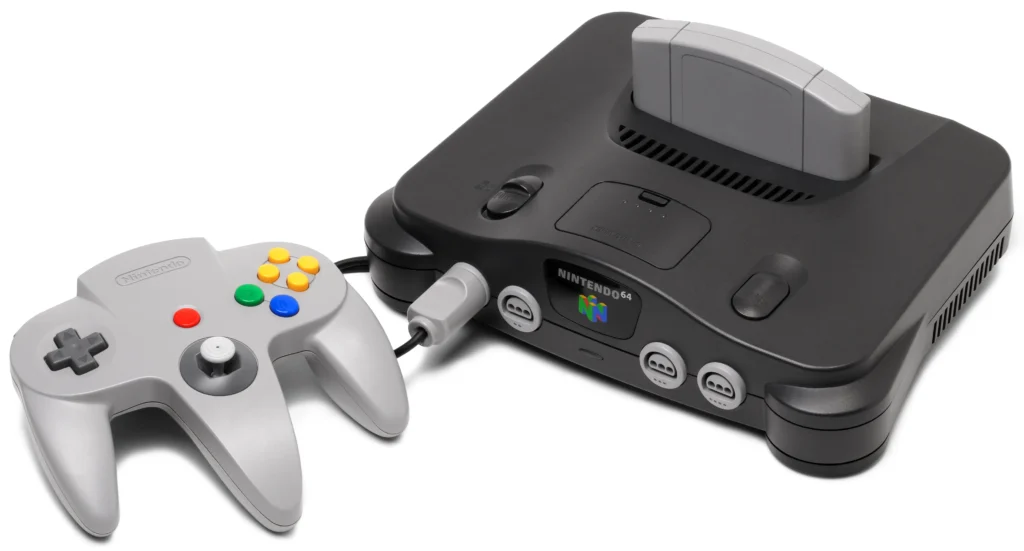
Image credit: Evan-Amos – Wikimedia Commons (Public domain).
1. Introduction and history
Released on June 23, 1996 in Japan (September 30, 1996 in the United States, and March 1, 1997 in Europe), the Nintendo 64 (N64) was the last major cartridge-based console of the fifth generation, competing directly with the PlayStation and the Sega Saturn. Developed in collaboration with Silicon Graphics, its NEC VR4300 CPU (93.75 MHz) and SGI-designed RCP graphics coprocessor provided support for texture mapping, Z-buffering, anti-aliasing, and trilinear filtering.
Despite its lower storage capacity compared to CD-based systems, its raw processing power enabled highly immersive experiences such as Super Mario 64, The Legend of Zelda: Ocarina of Time, and GoldenEye 007. The console sold over 32 million units worldwide before being discontinued in 2002. Its use of cartridges resulted in near-instant loading times, reduced FMV usage, and a lower reliance on optical media.
The Nintendo 64 represents a key stage in Nintendo’s evolution. To better understand the historical context and the design decisions behind this console, you can consult the history of Nintendo section.
2. Technical dpecifications
- CPU: The Nintendo 64 is powered by the NEC VR4300 processor, based on the 64-bit MIPS R4300i architecture. This CPU operates at a clock speed of 93.75 MHz and was designed to deliver strong performance in multimedia applications and 3D video games. Internally, it features a Level 1 cache of 24 KB, divided into 16 KB for instructions and 8 KB for data. Although the processor is fully 64-bit, in practice many games and system routines operate in 32-bit mode, as this was more efficient for certain tasks and easier to program during a period when the industry was transitioning between architectures. Even so, this CPU represented a significant leap forward compared to the 16-bit and 32-bit consoles of the previous generation.
- Graphics – RCP (Reality Coprocessor): Graphics processing on the Nintendo 64 is not handled by a conventional GPU, but by a dedicated coprocessor known as the RCP (Reality Coprocessor). This chip was developed jointly by Nintendo and Silicon Graphics (SGI), a company renowned for its professional 3D graphics technology. The RCP operates at 62.5 MHz and is divided into two main internal units:
- RSP (Reality Signal Processor): Responsible for tasks such as 3D geometry processing, transformations, lighting calculations, animations, and audio processing.
- RDP (Reality Display Processor): Handles the final image rendering, including texture mapping, depth buffering (Z-buffer), anti-aliasing, and graphical effects such as blur and reflections.
The system is capable of reaching up to 100 million floating-point operations per second (100 MFLOPS) and includes hardware-accelerated transformation and lighting (T&L), a feature that would not become standard in PC graphics hardware until several years later. This capability placed the console well ahead of its contemporaries in terms of three-dimensional graphics performance, although it also introduced certain challenges for developers due to its unconventional architecture.
- Memory (RAM): The console includes 4 MB of RDRAM (Rambus DRAM) as standard, using a 9-bit memory bus and operating at an effective frequency of 500 MHz. This type of memory was chosen for its extremely high bandwidth, theoretically reaching 562 MB/s, which was essential to sustain the graphics processing workload of the RCP and the overall system data flow.
One of the most notable features is the possibility of expansion via the Expansion Pak, which increases total system memory to 8 MB. Some titles required it in order to function properly—such as Donkey Kong 64 or The Legend of Zelda: Majora’s Mask—while others used it to enable higher resolutions, improved textures, or additional visual effects (Perfect Dark, Turok 2, Star Wars: Rogue Squadron). - Audio: Audio processing on the Nintendo 64 is handled by the RSP coprocessor, allowing for 16-bit stereo PCM audio at 44.1 kHz, comparable to CD-quality sound. Although the system does not feature a dedicated sound chip like earlier consoles, the RSP performs real-time digital audio mixing and effects processing. The console also supports Dolby Pro Logic, enabling surround sound output on compatible home theater systems. This allowed certain titles to deliver a significantly more immersive audio experience than was typical at the time.
- Physical Media: The Nintendo 64 used proprietary cartridges (Game Paks) as its sole storage medium, with capacities ranging from a few megabytes up to an official maximum of 64 MB (512 Mbit). While this choice provided advantages such as instant loading times, greater physical durability, and reduced piracy, it also severely limited storage capacity compared to the rising CD-ROM standard, which could hold up to 650 MB. This limitation posed challenges for third-party developers, who often found optical media more cost-effective and flexible, ultimately affecting the size and diversity of the console’s game library compared to its direct competitors.
- Power Supply: The console uses an external power supply unit, housed in a compact module that connects directly to the rear of the system. This power supply converts AC mains power into two DC output lines:
- 12 V / 0,8 A
- 3,3 V / 2,7 A
The total power consumption is approximately 18 watts. The console uses a proprietary power connector with 6 pins: one for 12 V, two for 3.3 V, and three for ground (GND). Power supplies are interchangeable between NTSC and PAL models, provided that the correct input voltage for each region is used (110 V or 220 V).
- Ports and Connectivity
- Controller Ports: The system features four integrated front controller ports, allowing local multiplayer out of the box without the need for additional adapters—an important advantage over competing systems at the time. Many games were specifically designed around this multiplayer capability.
- Expansion Slot: Located on the upper front section of the console, this slot allows the installation of either the Jumper Pak (standard configuration with no additional RAM) or the Expansion Pak, which doubles the system memory.
- Cartridge Slot: Positioned on the top of the console, this slot is standard across all models and accepts Nintendo 64 Game Paks.
- Audio/Video Output: The Nintendo 64 uses the Multi Out AV connector, the same interface found on the Super Nintendo and GameCube. It is compatible with RCA cables (composite video), S-Video, and, in some cases, RGB output via modification or specialized adapters. It was also possible to use an RF modulator for older televisions, although image quality was significantly reduced.
3. Technical revisions
- NUS‑CPU‑01 (1996, Japan): The first commercial revision, used exclusively in early Japanese launch models. It features a spacious internal layout closely resembling the original prototype design, with the main chips (CPU, RCP, DAC) more widely spaced and clearly visible. It already includes all elements that would become standard across the system: cartridge slot, front expansion bay, Multi Out connector, four controller ports, and the bottom expansion port (EXT) intended for the future 64DD. Extremely scarce and quickly replaced by more optimized later revisions.
- NUS‑CPU‑02 / 03 / 04 (1996–1997): The first revisions distributed globally, used in both Japanese and North American models. They retain the original system architecture, with discrete chips (such as the DAC and VDC-NUS) and a more generous PCB layout. These were the first boards fully compatible with most official and third-party peripherals, without space or interference issues.
Revision 04 introduced minor improvements to video filtering and internal component organization. - NUS‑CPU‑05 / 06 / 07 (1997–1998): Intermediate revisions aimed at production optimization. PCB complexity was reduced, and several components were integrated into more compact chips. Capacitor placement was revised, and some power lines were grouped more efficiently. These boards also appeared in regional batches with slight physical differences that affected compatibility with bulky devices (such as the Doctor V64 or certain early flash cartridges).
- NUS‑CPU‑08 (1998–1999): The first revision manufactured alongside the “Funtastic” models (the translucent consoles). It features a significant reduction in component count, increased functional integration into combined chips, and a more efficient use of internal space. This revision marks the beginning of a new, more cost-effective and standardized production phase.
- NUS‑CPU‑09 (1999–2000): A continuation of the simplification process. The PCB adopts an even more compact configuration with further circuit optimization. These boards were used in later Funtastic models as well as in standard consoles produced during the final years of manufacturing in North America and Japan.
- NUS‑CPU‑09-1 (2000–2002): The last known motherboard revision. It was used to conclude console production and supply final editions, such as the Pikachu Edition. It retains the overall structure of the NUS-CPU-09 but introduces minor layout changes (trace routing and component placement) intended to reduce assembly time.
- NUS‑CPU‑P‑01 / P‑02 (1997–1999, PAL models): Motherboards specifically designed for Europe and Australia. Internally similar to NTSC revisions 04–07, but adapted for PAL video standards (50 Hz), different color encoding, and other regional requirements. Compatible with NTSC peripherals, but featuring different internal firmware in support chips.
- NUS‑CPU‑P‑03 (1999–2002, PAL Funtastic): The final motherboard revision for PAL consoles, used in translucent models and limited editions. It integrates all changes introduced in the 09-1 series within a PAL configuration. This revision includes new internal video filters that slightly alter the video output, along with reworked AV output wiring compared to earlier PAL boards.
4. Official development environments and debugging kits
4.1. Official development kits
- SGI Indy + Ultra64 board: The first official development setup used by Nintendo and studios such as Rare during the early stages of development (Banjo-Kazooie, GoldenEye 007). It consisted of an SGI Indy workstation equipped with the Ultra64 expansion board, which added Nintendo 64–specific functionality and allowed developers to run and test software directly on SGI hardware.
- Partner‑N64 PC (by KMC): An official third-party development kit manufactured by Kyoto Microcomputer (KMC). It consisted of a development cartridge connected to a PC via ISA or LAN, enabling real-time debugging and software testing. This kit included:
- An ISA expansion card installed in the PC.
- Special development cartridges.
- A DCC board inserted into a debug N64 unit.
- Software tools for communication and control between the PC and the console.
- SN Systems SN64 / SN Maestro 64: A licensed development system created by SN Systems, widely used throughout the industry. It consisted of a development cartridge connected to a PC, allowing compilation, debugging, and real-time testing. The system integrated seamlessly with SN Systems’ professional development tools and became one of the most common N64 development environments.
- 64DD Dev Kit: An extension of the standard N64 development kit designed to support the 64DD peripheral. It included the necessary BIOS, an additional 4 MB of RAM, and specific development tools required for software targeting the magnetic disk system. This kit was used internally during the development of 64DD hardware and software.
- N64 Flash Gang Writer: An official programming device used by Nintendo and licensed developers to write data to multiple development cartridges simultaneously. Manufactured by Intelligent Systems, this unit allowed developers to flash up to eight development cartridges at once, connecting to a PC or workstation.
Unlike commercial cartridges, these development carts contained flash memory or EPROMs that could be erased and reprogrammed multiple times. This made them ideal for internal testing, debugging, demo distribution, and press builds. Use of the Flash Gang Writer was restricted to professional environments and formed part of the official Nintendo 64 and 64DD development ecosystem.
4.2. Unofficial development kits, backup hardware, and homebrew tools
- ROM Loading and Execution
- Doctor V64 (Bung Enterprises): A pioneering device that connects to the bottom expansion port of the console and allows ROMs to be loaded from CD-ROM. Although originally designed as a backup unit, it was widely used in alternative development and the homebrew scene.
- Z64: An alternative to the Doctor V64. It uses 100 MB ZIP disks to load games and connects directly to the cartridge slot on top of the console. It features an integrated LCD screen that allows ROM management and system control without the need for a PC.
- CD64: Similar in concept to the Doctor V64, but designed to connect directly to the top cartridge slot. It uses CD-ROMs and allows backups, ROM loading, and homebrew testing. It became popular due to its ease of use and compatibility.
- 64Drive / EverDrive 64: Modern flash cartridges that allow games to be loaded from an SD card with near-perfect hardware compatibility. Today they are widely used for homebrew development, software testing, and accurate game preservation.
- ROM Adapters (Generic): Unofficial interfaces that allow ROMs to be sent from a PC or external device to the console. Some were experimental prototypes, while others were produced in limited commercial runs.
- Debugging and Development Tools
- IS Viewer 64: An official or semi-official debugging cartridge used in development environments to monitor memory, display debug data, and interact with software in real time during execution.
- Monegi Smart Pack: A lesser-known Japanese development kit consisting of a special cartridge, interface hardware, and PC connection cables. It was intended for real-time debugging and in-game data editing.
- SN64 Dev Kit – Maestro 64 (SN Systems): A specialized variant of the SN64 development environment focused on audio processing. It allowed developers to transfer and test sound data directly on the console and was widely used in professional audio production workflows.
- Save Data Management
- DexDrive (Interact): A PC-connected accessory (via serial port) that allowed users to transfer save data from the Controller Pak. It became very popular for backing up saves and sharing them online during the late 1990s and early 2000s.
“Some devices such as the Doctor V64 or CD64 served a dual purpose, functioning both as backup units and software execution tools. They were widely adopted by unlicensed developers and homebrew enthusiasts, playing a significant role in the early Nintendo 64 development and preservation scene.”
5. Colors and special editions
- Charcoal / Standard Grey
The original dark gray color scheme, released in Japan (1996), the United States (1996), and Europe (1997). This was the standard launch version and the most widely distributed model. - Funtastic Series (2000)
A collection of six translucent color variants released in North America, Europe, and Australia as part of the Funtastic marketing campaign:- Jungle Green
- Ice Blue
- Grape Purple (known as Midnight Blue in Japan)
- Fire Orange (marketed as Sun Orange in Europe)
- Smoke / Clear Black
- Watermelon Red (known in Europe as Fire Red).
- Clear (top translucent / bottom white or grey)
- Clear White / Blue: Released in Japan (1999) and later in Europe as part of the Super Mario 64 bundle (2001).
- Clear White / Red: Japan-exclusive model released in 1999.
- Special and Regional Editions
- Pikachu Edition: A special edition featuring a blue and yellow shell, a raised Pikachu figure on the console, modified buttons, reset switch, and LED indicators. Released in the United States, Europe (2000–2001), and Japan (Light Blue and Orange variants).
- Daiei Hawks:A translucent orange-and-black model produced exclusively to commemorate the 1999 championship of the Fukuoka Daiei Hawks baseball team. Sold only through Daiei department stores in Japan, its color scheme reflects the team’s branding. Extremely rare.
- Gold Console: A gold-colored edition released in the United States and Japan through Toys “R” Us, featuring a metallic finish and matching controller. Marketed as a limited edition in 2001, it quickly became a highly sought-after collector’s item.
- JUSCO 30th Anniversary: A translucent gray console with a solid-color lower shell, released in Japan to celebrate the 30th anniversary of the JUSCO retail chain. Produced in very limited quantities and slightly different in tone compared to other translucent models.
- ANA All Nippon Airways: A white and light-blue console decorated with ANA branding. Released as part of a promotional campaign in 1999 and distributed through ANA flights and special events, including the famous Pokémon-themed aircraft. One of the rarest N64 variants.
- Hyundai Comboy (Corea): An officially licensed model manufactured by Hyundai for the South Korean market. The console is nearly identical to the standard gray model, with differences limited to branding and regional packaging.
- Controllers
Nintendo 64 controllers were typically color-matched to their respective console editions. In addition to those included with Funtastic and special-edition systems, Nintendo also released several standalone color variants, many of which were never paired with a matching console and are therefore considered complementary editions.- Solid Color Controllers
- Red
- Blue
- Green
- Yellow
- Black
- Additional Translucent Controllers
- Atomic Purple: A translucent purple controller not part of the Funtastic line. Sold separately in North America, it became one of the most iconic and recognizable N64 controller variants.
- Extreme Green: A vivid green translucent controller released as a standalone accessory or in limited bundles. It has no matching console and is highly regarded by collectors.
- Solid Color Controllers
6. NUS codes
Nintendo organized its entire ecosystem of hardware and accessories using an internal numbering system known as NUS codes (short for Nintendo Ultra 64). Each official device was assigned a unique identifier that makes it possible to determine its function, compatibility, and position within the Nintendo 64 accessory lineup. The following list presents all known peripherals in an organized manner according to their corresponding NUS codes.
6.1. Peripherals
- NUS‑002 – Power Supply: Official external power supply providing 12 V and 3.3 V DC to the console. It connects directly to the rear of the system.
- NUS‑003 – RF Modulator: Converts the AV signal to RF for televisions without composite video inputs. Requires the RF Switch (NUS-009) to operate.
- NUS‑004 – Controller Pak: Memory card inserted into the controller, used to store save data for games without internal SRAM.
- NUS‑005 – Nintendo 64 Controller: Standard controller featuring an analog stick, C-buttons, and expansion port. Available in multiple colors and special editions.
- NUS‑007 – Expansion Pak: 4 MB RAM expansion module that increases total system memory to 8 MB. Required for certain games and used to enhance performance and visual quality.
- NUS‑008 – Jumper Pak: Termination module for the expansion slot. Required when the Expansion Pak is not installed.
- NUS‑009 – RF Switch: Signal selector used in conjunction with the RF Modulator, allowing multiple consoles to share a single antenna input.
- NUS‑010 – Unidad 64DD: Magnetic disk expansion unit released exclusively in Japan in 1999. Connects to the underside expansion port and uses rewritable 64 MB disks.
- Adds features such as dynamic storage, content editing, a real-time clock (RTC), and support for exclusive software like Mario Artist, SimCity 64, and F-Zero X Expansion Kit. The 64DD was only sold as part of the Randnet Starter Kit, which included the modem, Expansion Pak, network software, and optionally the official keyboard. Its limited release and low adoption make it one of the rarest Nintendo peripherals ever produced.
- NUS‑012 – Jumper Pak Ejector: Plastic tool included with the Expansion Pak, used to safely remove it from the console.
- NUS‑013 – Rumble Pak: Vibration accessory powered by two AAA batteries. Plugs into the controller’s expansion slot.
- NUS‑017 – 64DD Mouse: Pointing device compatible with 64DD software. Exclusive to the Japanese market.
- NUS‑019 – Transfer Pak: Allows Game Boy and Game Boy Color cartridges to be inserted into the controller, enabling data transfer with games such as Pokémon Stadium.
- NUS‑020 – VRU (Voice Recognition Unit) – Module 1: Primary component of the voice recognition system used in games such as Hey You, Pikachu!.
- NUS‑021 – VRU – Module 2: Secondary unit required for full operation of the VRU system.
- NUS‑022 – VRU – Microphone Clip: Accessory used to attach the VRU microphone to the controller.
- NUS‑023 – SmartMedia Cartridge: Official cartridge for Mario no Photopi, featuring dual SmartMedia slots for importing images. Released exclusively in Japan.
- NUS‑025 – VRU – Microphone: Microphone component of the Voice Recognition Unit. Connects to the clip (NUS-022).
- NUS‑026 – Microphone Foam Cover (VRU): Yellow foam windscreen used to reduce ambient noise during voice input.
- NUS‑028 – Video Capture Cassette: Special cartridge used to capture images and video in 64DD software such as Mario Artist: Talent Studio.
- NUS-029 – 64DD Modem (Randnet): Cartridge-based modem used to connect the Nintendo 64 to the Randnet online service via telephone line. Included in the Randnet Starter Kit.
- RND‑001 – Randnet Keyboard (JPN): Official keyboard for the Randnet service. Connects via the controller port and allows text input in applications such as Mario Artist: Communication Kit. Supports both Latin and Japanese characters and features LED indicators. Although it does not carry an NUS code, it was officially manufactured and distributed by Nintendo as part of the 64DD ecosystem.
- NUS‑A‑BIO‑JPN – Bio Sensor: Heart-rate sensor that connects to the controller and measures pulse in real time. Used primarily with Tetris 64. Exclusive to Japan.
6.2. Other relevant NUS codes (non-peripheral devices)
In addition to standard peripherals, several other items were assigned NUS codes despite not being considered accessories in the traditional sense. These include magnetic disks for the 64DD, cleaning tools, special-purpose cartridges, and internal development hardware.
There are also several officially registered NUS codes for which no corresponding product has ever been identified. These may relate to cancelled prototypes, region-specific products that were never released, or reserved identifiers for planned expansions that were ultimately abandoned.
- NUS‑001 – Nintendo 64 Console (Control Deck): General identification code for the Nintendo 64 console itself.
- NUS‑006 – Game Pak (Cartridge Format): Base code used to identify all official Nintendo 64 game cartridges.
- NUS‑011 – 64DD Disk: 64 MB magnetic disk used with the 64DD system. Titles such as F-Zero X Expansion Kit and Mario Artist were released on this format.
- NUS‑014 – Cleaning Kit (Cartridge Slot): Special cleaning cartridge designed to clean the internal cartridge connector of the console.
- NUS‑015 – Cleaning Kit (Controller): Accessory used to clean the controller expansion port contacts.
- NUS‑016 – Cleaning Kit (Additional Connectors): Cleaning tool intended for other connectors, such as AV or expansion ports.
- NUS‑018 – [Unidentified Function]: Officially registered code with no confirmed associated device. Believed to correspond to a cancelled prototype or unreleased accessory.
- NUS‑024 – [Unidentified Function]: Known NUS code with no publicly documented hardware associated with it.
- NUS‑027 – [Unidentified Function]: Another registered code with no confirmed product. Likely reserved or unused.
- NUS‑030 and higher – [Reserved / Unknown Use]: Later NUS codes appear in internal records but are not associated with any officially released peripherals. These are assumed to be reserved identifiers or placeholders for unreleased hardware.
- NUS‑101 – Nintendo 64 Pikachu Edition: Special edition console released in 2000 in Japan, the United States, and Europe. Features a light blue casing with a molded Pikachu figure on top. The left cheek functions as the power button and lights up when the console is turned on, while the Reset button is styled as a Poké Ball. Although technically identical to standard models, the console lacks an accessible expansion port on the underside, making it incompatible with the 64DD.
- NUS DCC‑00 – «Nintendo 64 DCC Board»: Debugging circuit board used as part of the Partner-N64 PC development system. Installed internally in debug consoles or special enclosures, it provides access to internal buses, debugging signals, and memory read/write operations. Intended strictly for development and testing environments.
- Development Cartridges
Rewritable cartridges used exclusively for software development and testing. These were never sold to consumers.- NUS‑8F16F / 8F16FB: 16 MB flash cartridges, with or without an additional 256 KB of RAM (the “B” variants include RAM).
- NUS‑16F32SB: A 16 MB flash cartridge with 256 KB of RAM, widely used for press builds and internal testing.
- NUS‑16F32S: Similar to the previous model but without the “B” designation. Less documented, but officially listed in Nintendo development records.
7. Representative games and official game list
- Super Mario 64.
- GoldenEye 007.
- The Legend of Zelda: Ocarina of Time.
- Perfect Dark.
- Star Fox 64.
- Wave Race 64.
- Tetris 64.
- Densha de Go!
- Complete List of Official Nintendo 64 Games.
8. Modifications and enhancements
This section will be gradually expanded with fully documented modifications, hardware experiments, and Nintendo 64–related projects.
Guiamodconsolas prioritizes publishing only tested and properly documented content, so this section will grow as projects are completed and verified.
9. Curiosities
- The Nintendo 64 was the last major cartridge-based home console, prioritizing speed over storage capacity.
- The 64-bit VR4300 CPU was the most powerful processor used in a home console at the time of its release.
- Majora’s Mask and Perfect Dark require the Expansion Pak for the full gameplay experience.
- The controller introduced the analog stick and the distinctive Z-trigger, setting a new standard for 3D controls.
- Star Fox 64 popularized the Rumble Pak, one of the first widely adopted vibration accessories in gaming.
- The system used RDRAM instead of SDRAM for performance reasons, despite its higher cost.
- The console supported up to four players natively, a design choice driven by Shigeru Miyamoto’s vision for multiplayer gaming.