
The history of Nintendo is an unlikely journey, from traditional playing cards in Kyoto to the hearts of millions of players around the world. A pioneer, timeless and constantly reinventing itself, Nintendo didn’t just create games. It redefined what it meant to play. This is its story.
1. Foundation and early years (1889–1969)
From traditional playing cards to mechanical toys
The history of Nintendo begins long before video games existed. In 1889, in the Shimogyō district of Kyoto, a young craftsman named Fusajirō Yamauchi founded a small company called Nintendo Koppai, dedicated to the handmade production of Hanafuda playing cards, traditional Japanese cards used for both recreation and gambling.
The company quickly gained a strong reputation for the quality of its products, becoming one of Japan’s most important playing card manufacturers. Over the following decades, Nintendo experimented with different card designs, including Western-style decks and sets decorated with popular imagery. Its connection to entertainment, though not yet electronic, was already firmly established from the very beginning.
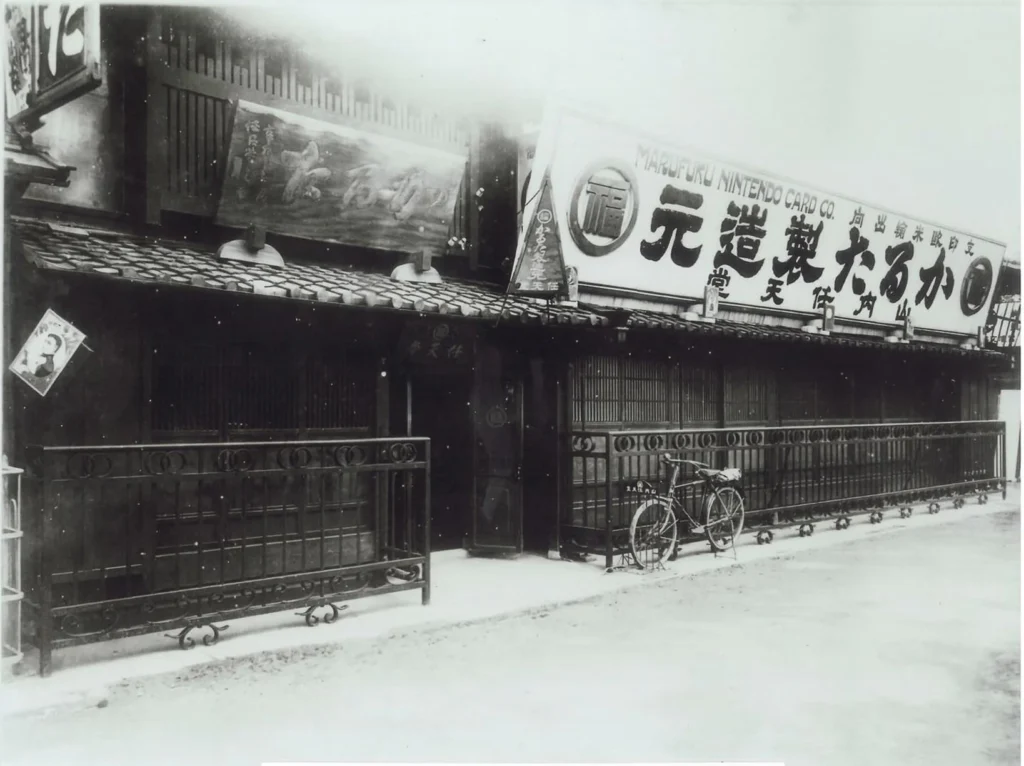
Image credit: Wikimedia Commons (Public domain).
Origins of Nintendo and the transition into entertainment
· A family business in evolution
The company remained under family control for decades, eventually coming under the leadership of Hiroshi Yamauchi, the great-grandson of the founder, in 1949. His arrival marked a decisive turning point in Nintendo’s history.
Yamauchi was young, ambitious, and possessed a modern business mindset. He quickly centralized control of the company, renamed it Nintendo Playing Card Co., Ltd., and began seeking new opportunities beyond the playing card business, which was already showing signs of decline.
· The years of experimentation
Throughout the 1950s and 1960s, Nintendo explored a wide range of business ventures in an effort to diversify. Some of these attempts were surprisingly unconventional:
- A taxi company, which ultimately failed due to poor management.
- Instant food products, unable to compete with established brands.
- Even a “love hotel”, which was short-lived after damaging the company’s family-friendly image.
Although unsuccessful, these ventures demonstrated Nintendo’s constant search for reinvention and its willingness to experiment beyond traditional boundaries.
· The arrival of toys
The true turning point came when Yamauchi created an internal toy development department. This was when a key figure entered the scene: Gunpei Yokoi, a self-taught engineer who would become renowned for his practical and creative approach.
Yokoi designed products such as:
- Ultra Hand (1966): an extendable toy arm that became a massive commercial success.
- Ultra Machine, Love Tester, and other mechanical gadgets with light electronic elements.
Nintendo had discovered a new path: interactive entertainment. The transition from playing cards to toys was not merely a shift in market focus, it was a conceptual evolution that laid the groundwork for everything that would come next.
“Nintendo was not born as a video game company. But it was always a company dedicated to entertainment.”
2. The electronic awakening (1970–1982)
Technology, creativity, and a new industry in the making
By the early 1970s, Nintendo was already a well-established company in the Japanese toy market. However, the real turning point came when the company began combining its toy-making expertise with the emerging field of consumer electronics. This moment not only transformed Nintendo itself, but also helped lay the foundations of an entirely new industry.
From electronic toys to video games
· The influence of Gunpei Yokoi
The driving force behind many of these innovations was Gunpei Yokoi, whose philosophy would define Nintendo’s approach for decades to come:
“Lateral thinking with withered technology”.
Rather than chasing cutting-edge hardware, Yokoi focused on using mature, inexpensive, and well-understood technology in creative ways. His goal was not technical supremacy, but efficiency, accessibility and fun, a philosophy that would become central to Nintendo’s identity.
· First steps into electronic games
Between 1970 and 1974, Nintendo began experimenting with devices that combined electronics and play:
- Love Tester: a novelty device designed to measure “romantic compatibility,” more of a humorous gadget than a serious technical product.
- Beam Gun: light-based toy guns that interacted with photo-sensitive targets, an idea that would later evolve into arcade machines and home peripherals.
These early inventions laid the technical and conceptual foundations for what was to come: interactive entertainment as a mass-market product.
· Entering the arcade industry
By the mid-1970s, arcades were becoming increasingly popular worldwide. Nintendo, always attentive to new entertainment trends, decided to test its luck in this emerging sector. In 1975, the company released EVR Race, an experimental arcade machine that used video tape playback to simulate horse racing. While technically interesting, it failed to leave a lasting impact in arcades.
This first attempt marked the beginning of a period of experimentation and uncertainty.
· Exploration and early failures
Between 1975 and 1980, Nintendo explored various arcade concepts, combining innovation with technological limitations:
- EVR Race (1975), as mentioned above.
- Block Fever (1979) and other Pong-style games, which served mainly as learning experiences.
During this period, Nintendo had not yet developed a clear identity as a video game company, but it was steadily gaining experience in game design, electronics, and distribution.
At the same time, the company entered the Japanese home market with the Color TV-Game series (1977–1980), dedicated consoles with built-in games. These systems sold millions of units and helped establish Nintendo’s future focus on home entertainment.
In 1979, Nintendo launched a more ambitious project: Radar Scope, a space shooter intended to replicate the success of Space Invaders in the United States. Although technically impressive, the game was a commercial failure. Unsold arcade cabinets piled up in warehouses, and Nintendo’s American subsidiary found itself on the brink of collapse.
Ironically, this setback would become the catalyst for the creation of one of the most iconic characters in video game history…
· Shigeru Miyamoto and the birth of a legend
In 1981, with hundreds of unsold Radar Scope arcade boards sitting in warehouses, Nintendo desperately needed a way to repurpose the hardware. The task of creating a new game fell to a young in-house designer with no prior programming experience: Shigeru Miyamoto.
His original idea was to create an adaptation of Popeye, but after failing to secure the license, he designed new characters that fulfilled similar roles:
- Jumpman (later known as Mario) in place of Popeye.
- Donkey Kong in place of Bluto.
- Pauline in place of Olive Oyl.
Thus, Donkey Kong was born, a platform arcade game with innovative mechanics, colorful graphics, and accessible yet challenging gameplay. It became a massive success in Japan and, especially, in the United States, where it established Nintendo as a major new force in the interactive entertainment industry.
· Game & Watch: The portable revolution
That same year, Gunpei Yokoi introduced another brilliant idea: the Game & Watch series, small handheld devices featuring a single game and a built-in clock.
- Low-power LCD screens
- Clamshell designs in some models, which would later inspire future handheld consoles
- The first appearance of the directional pad (D-pad), which would become an industry standard
These handhelds were a worldwide success and firmly established Nintendo as a leader in accessible, innovative entertainment.
“While others chased graphical power, Nintendo had already understood the power of smart design.”
3. The rise of a legend (1983–1989)
Nintendo and the revival of the video game industry
After years of trial and error, setbacks, and experimentation, Nintendo finally found its voice. In an industry shaken by the collapse of the U.S. video game market, the Japanese company chose to rebuild gaming from the ground up—focusing on design, control, quality, and trust. With two key moves, a revolutionary home console and an unexpectedly successful portable system, Nintendo not only restored confidence in video games but also laid the foundation for its global dominance.
3.1. Nintendo Entertainment System / Famicom: A new home for video games
In 1983, the Famicom launched in Japan with a simple yet powerful concept: high-quality games on an accessible, colorful system with a strong identity. Two years later, redesigned as the NES, it achieved what seemed impossible, reviving the collapsed North American video game market. Thanks to titles such as Super Mario Bros. and The Legend of Zelda, Nintendo became synonymous with video games for an entire generation.
· The Famicom: Accessible elegance
The Family Computer (Famicom) was released in Japan in July 1983. Compact and finished in white and red, it offered:
- Interchangeable game cartridges.
- Color graphics with smooth scrolling.
- Multi-channel audio.
- Controllers integrated into the console, featuring a digital directional pad.
Designed by Masayuki Uemura, the Famicom was an immediate success in Japan. Its early catalog included high-quality arcade conversions such as Donkey Kong, Popeye, and Mario Bros...
It wasn’t the first home console, but it was the first to truly get everything right.
· The crash of 1983 and the opportunity
Meanwhile, in the United States, the video game market was experiencing its darkest moment. The crash of 1983 devastated companies like Atari, Mattel, and Coleco, in an industry overwhelmed by low-quality games, rampant cloning, and unreliable hardware.
Nintendo saw an opportunity where others saw collapse. It decided to bring its console to the Western market, but under a different name and with a carefully planned strategy.
· Nintendo Entertainment System (NES)
In 1985, Nintendo launched the redesigned Famicom in North America as the Nintendo Entertainment System (NES).
- A “video appliance” appearance, more serious and robust.
- Inclusion of peripherals such as the Zapper light gun and R.O.B., designed to distance the system from the image of failed game consoles.
- A marketing strategy centered on quality and trust, reinforced by the “Nintendo Seal of Quality”.
Nintendo wasn’t just selling hardware. It was selling confidence in video games again, something the Western industry had completely lost.
· Super Mario Bros. and the design revolution
In 1985, alongside the Western launch of the NES, Nintendo released the game that would redefine the medium: Super Mario Bros., created by Shigeru Miyamoto.
- Smooth side-scrolling.
- Progressive and intuitive level design.
- Memorable music.
- Unprecedented control precision.
Super Mario Bros. was not just a commercial success; it was a design manifesto that established the foundations of modern video game design and demonstrated what interactive entertainment could truly be.
· Strict policies, a golden catalog
Nintendo imposed strict rules for publishing games on its system:
- A limit on the number of titles per company per year.
- Strict control over cartridge manufacturing.
- Content supervision and quality standards.
his approach resulted in a far more polished and professional game library. Nintendo ensured that its console would not suffer the same excesses that had plagued Atari. Companies such as Capcom, Konami, Namco, and Hudson developed some of their most iconic franchises for the NES during this period.
“If the Famicom was the spark, the NES was the fire. Nintendo didn’t just enter homes, it reclaimed them.”
3.2. Game & Watch: The first steps into portable gaming
In the early 1980s, while Nintendo was beginning to stand out in the arcade world with hits like Donkey Kong, the company was also quietly laying the foundations for another revolution: portable gaming. Once again, the driving force behind this innovation was Gunpei Yokoi, one of Nintendo’s most influential engineers…
· Game & Watch: One console, one game, one era
Released in 1980, the Game & Watch series introduced simple handheld devices, each featuring a single game. They used LCD screens, basic controls, and in many models included a built-in clock with an alarm function.
Their simplicity, portability, and elegant design made them an immediate success, especially among students and office workers. They were the first consoles to turn video games into an everyday activity, no longer confined to arcades or the living room.
· A testing ground for the future
Game & Watch was not only popular, it also served as a testing ground for ideas that would shape Nintendo for decades to come. Among its most important innovations was the directional pad (D-pad), introduced in the Donkey Kong model (1982). This control method revolutionized how games were played and would go on to become an industry standard. It was also Nintendo’s first product to be mass-produced and sold internationally, achieving major success in both Europe and North America.
· Design, identity, and legacy
With over 40 models released, Game & Watch not only cemented Nintendo’s position as a hardware manufacturer but also established many of the company’s defining traits: charming characters, functional design, and accessibility. Characters such as Mr. Game & Watch, born from this series, remain iconic to this day, most notably through their appearances in Super Smash Bros.
· A key step in Nintendo’s expansion
Although often overshadowed by the later success of the Game Boy, Game & Watch units sold over 43 million units worldwide. They provided a stable source of revenue during a critical period of growth and international expansion for Nintendo. More importantly, they laid the technological, conceptual, and philosophical foundations for Nintendo’s future dominance in handheld gaming.
“Nintendo didn’t just conquer the living room — it fit itself into the pockets of an entire generation.”
4. A double pixelated impact (1990–1996)
Two fronts of the same legacy
With the arrival of the 1990s, Nintendo faced a new challenge: maintaining its leadership in an increasingly competitive and diverse market. The 16-bit era brought with it one of the greatest rivalries in video game history, but it also marked the birth of a new front, portable gaming. While the Super Nintendo battled SEGA in living rooms around the world, the Game Boy conquered millions of players from their pockets. Two different ways of playing, driven by the same philosophy: fun without compromise.
4.1. Super Nintendo: Refining a formula
As the new decade began, the video game industry entered one of its most vibrant and competitive eras: the 16-bit generation. This period not only represented a technical leap forward but also a moment of cultural consolidation for the medium.
Nintendo, which had dominated the previous decade, now faced a bold rival in SEGA, whose aggressive and stylish approach challenged Nintendo’s supremacy. The Super Nintendo and the Mega Drive (Genesis) would go on to define one of the most iconic rivalries in entertainment history, a battle marked by creativity, innovation, and fierce competition for the hearts of players worldwide.
· A natural evolution
Released in 1990 in Japan (as the Super Famicom) and in 1991 in North America, the Super Nintendo Entertainment System (SNES) took the legacy of the NES to the next level:
- 16-bit graphics with advanced effects such as Mode 7, transparency, and rotation.
- Sony SPC700 sound chip, delivering rich, complex, and memorable music.
- Controllers with four face buttons and shoulder triggers, setting a new industry standard.
- Conceptual backward compatibility, maintaining the same design philosophy of precision and accessibility.
The SNES did not seek to impress through raw aggression, but through refinement, balance and polish, a philosophy that would define many of Nintendo’s greatest successes.
· The duel with SEGA
SEGA, with its Mega Drive (known as the Genesis in the United States), had entered the 16-bit arena earlier and adopted a far more aggressive, youth-oriented marketing strategy. “SEGA does what Nintendon’t” was its slogan, a provocative and direct message suggesting that SEGA offered what Nintendo could not or would not: more power, more speed, and a bolder, more rebellious image.
The market quickly split into two camps. While SEGA focused on speed and attitude (with Sonic as its flagship), Nintendo emphasized depth and craftsmanship (The Legend of Zelda, Super Metroid).
Both consoles coexisted strongly, but Nintendo held firm and ultimately dominated in Japan, where the SNES achieved overwhelming sales and critical acclaim.
· The chip as an ally: FX, SA-1, and beyond
To keep pace with technological advances, Nintendo adopted a brilliant strategy: embedding special chips directly into game cartridges.
This approach allowed the company to expand the system’s capabilities without altering the base hardware:
- Super FX: used in Star Fox to enable real-time 3D polygon graphics.
- SA-1: used in Super Mario RPG to accelerate processing and handle more complex environments.
- Other enhancement chips enabled advanced rotation effects, scaling, artificial intelligence, and more.
Thanks to this modular approach, the SNES remained technologically relevant until the very end of its lifecycle.
· An unmatched game library
The Super Nintendo solidified many of the most important franchises in video game history, both first-party and third-party:
- The Legend of Zelda (A Link to the Past)
- Metroid (Super Metroid)
- Final Fantasy (Final Fantasy VI)
- Chrono (Chrono Trigger, which launched one of the medium’s most revered franchises)
- Donkey Kong (reinvented with Donkey Kong Country)
- Yoshi (introduced with Yoshi’s Island)
- Mario Kart (born with Super Mario Kart)
Each of these titles was more than a commercial success, they defined gameplay standards and design philosophies that continue to influence the industry today.
· Nintendo and censorship: Content control
During this period, Nintendo enforced a strict content policy in Western markets:
- Removal of religious references, blood, alcohol, or nudity.
- Cultural localization and adapted translations.
This earned the company a reputation as being “child-oriented,” while SEGA positioned itself as the more “mature” alternative. However, on a family level, Nintendo gained the trust of parents and educators, securing its place in the living room as a safe and reliable form of entertainment.
· The end of the generation: A powerful but conservative Nintendo
By 1996, with the release of Super Mario RPG and Kirby’s Dream Land 3, Nintendo closed one of the most successful chapters in its history.
The video game industry was preparing for the leap into 3D, and while Sony was beginning to emerge with the PlayStation, Nintendo was gearing up for its next great challenge.
“The SNES was not just a console, it was a school of design. And its legacy still lives on in today’s controllers, genres, and standards.”
4.2. Game Boy: A handheld that vhanged the world
In contrast to the graphical arms race of the 16-bit era, Nintendo took a very different approach to portable gaming. Released in 1989, the Game Boy combined simplicity, battery life, and an enormous library of accessible games.
Despite its monochrome screen, it became a global phenomenon thanks to its durability, affordable price, and above all, one legendary cartridge: Tetris. Throughout the decade, the Game Boy not only withstood competition, it surpassed it, becoming one of the best-selling and longest-lived gaming systems of all time.
· A concept built on essentials
Designed by Gunpei Yokoi, the Game Boy embodied the philosophy of “mature technology used wisely.” Its hardware was modest: a monochrome screen, four AA batteries, and no backlight. Yet these limitations allowed for exceptional battery life and low production costs.
This balance between simplicity, reliability, and fun would become one of Nintendo’s greatest strengths, and a defining principle of its portable systems for decades to come.
· Tetris: The perfect game at the perfect time
The masterstroke was bundling Tetris with the console. Its universal and addictive gameplay broke all generational and cultural barriers. Millions of people, even those who had never considered themselves gamers, became captivated by the simple yet hypnotic Russian puzzle game. The combination was explosive: the Game Boy sold over 118 million units worldwide.
· Pokémon: The second explosion
If Tetris was the hook, Pokémon was the fishing rod. In 1996, Pokémon Red and Blue revitalized the system just as it was beginning to show signs of aging. The mechanic of trading creatures between consoles using the Link Cable transformed gaming into a social and collectible experience. It was a second turning point. Once again, the Game Boy found itself at the top of the industry.
· Refined models for a changing era
Before giving way to a new generation, Nintendo released improved versions of the Game Boy that refined the original concept:
- Game Boy Pocket (1996): Thinner, lighter, and featuring a much clearer screen that eliminated the original model’s ghosting effect. It retained full compatibility while offering a more comfortable and modern experience.
- Game Boy Light (1998, Japan only): The first Game Boy model with a backlit screen, ideal for playing in low-light conditions. Although released in limited numbers, it anticipated a feature that competitors would later adopt as standard.
These revisions strengthened Nintendo’s dominance in the portable market just before the arrival of the Game Boy Color, extending the life of the original system and paving the way for its evolution.
· A legendary game library
From The Legend of Zelda: Link’s Awakening to Metroid II, from Wario Land to Kirby’s Dream Land and Donkey Kong ’94, the Game Boy built its own mythology. Far from being “lesser” versions of console games, many of these titles embraced limitation as a strength, delivering gameplay experiences that remain timeless.
“The Game Boy didn’t just invent modern portable gaming, it made it part of everyday life.”
5. A change of dimension (1996–2001)
From polygons to experimentation, with two controllers in hand
With the transition to 3D graphics, video games underwent a profound transformation in narrative, design, and control. Nintendo, far from simply following the trend, sought to lead it in its own way. This ambition gave rise to two very different yet complementary systems: one focused on redefining three-dimensional space through a revolutionary controller, and another willing to experiment with new forms of interaction in a portable format. It was a decade of discovery, risk-taking, and bold ideas, a period that would shape the future of gaming for generations to come.
5.1. Nintendo 64: Rewriting the rules of 3D gaming
With the Nintendo 64, the company set out to reinvent the way games were played. Its unconventional controller, featuring an analog stick and the iconic Z-trigger, introduced an entirely new way of interacting with virtual worlds. Super Mario 64 was not just a launch title, it was a manifesto that defined 3D game design for years to come. Despite the limitations imposed by cartridge-based media compared to CD-ROMs, Nintendo remained faithful to its philosophy: gameplay above all else.
· Nintendo 64: A no-compromise vision
Released in 1996, the Nintendo 64 was Nintendo’s first home console built around true 3D graphics. Developed in collaboration with Silicon Graphics, its architecture focused on raw power and advanced graphical processing.
Its defining features included:
- 64-bit CPU, proudly reflected in its name.
- Analog stick and Z-trigger, revolutionizing 3D control.
- First widespread use of force feedback, via the Rumble Pak.
- Cartridge-based media instead of CDs, ensuring fast loading times but severely limiting storage capacity.
Nintendo rejected the CD format out of concern for loading times and piracy. While this decision preserved performance and reliability, it also discouraged many third-party developers, who instead embraced Sony’s PlayStation.
· Super Mario 64: A new language of play
The true debut of the N64 was Super Mario 64, a title that redefined what 3D gameplay could be. It introduced:
- Precise analog control.
- Free movement in fully 3D environments.
- A semi-automatic camera system (represented by Lakitu).
Open-ended level design with unprecedented freedom. Its physics system and level structure created a sense of exploration never before seen on consoles. Super Mario 64 became the blueprint for 3D game design for decades to follow.
· The rebirth of Zelda: Ocarina of Time
In 1998, Nintendo released what many still consider one of the greatest video games ever made: The Legend of Zelda: Ocarina of Time.
- Cinematic storytelling.
- A seamless, interconnected world.
- The revolutionary Z-targeting combat system.
- A dynamic musical system deeply integrated into gameplay.
Ocarina of Time didn’t merely translate Zelda into 3D, it elevated it into interactive art. Its influence can still be felt in modern action-adventure games, and it remains a benchmark for design, pacing, and immersion.
· Problems with Third-Party developers
The use of cartridges, combined with Nintendo’s strict licensing policies, led many major developers, such as Square, Capcom and Enix, to shift their focus to the PlayStation. This significantly limited the N64’s third-party library, leaving the console heavily dependent on Nintendo itself, Rare, and a small group of collaborators.
Despite outstanding titles such as Banjo-Kazooie, GoldenEye 007, Wave Race 64, Perfect Dark, Majora’s Mask, and Paper Mario, the console never reached the commercial dominance previously achieved by the NES or SNES.
· A different philosophy
During this generation, Nintendo defended a very clear idea: “Less is more if it’s done well.” While Sony pushed multimedia features, CD storage, and cinematic presentation, Nintendo focused on precision, gameplay purity, and mechanical depth.
This approach came at a cost in market share… but it preserved the company’s identity intact.
· End of an era and new challenges ahead
The generation came to a close with the release of Conker’s Bad Fur Day in 2001 a bold, irreverent title that symbolized both the creative freedom and the contradictions of the platform.
Nintendo had endured the transition to 3D and proven its design mastery once again.
But it was clear that the company was no longer leading the industry, it was now defending its philosophy in a rapidly changing market.
“With the Nintendo 64, the company did not lose itself in three dimensions, it conquered them, in its own way.”
5.2. Game Boy Color: A quiet but effective transition
In 1998, while the broader market embraced the leap to 3D, Nintendo released the Game Boy Color, a modest yet highly effective evolution of its iconic handheld. Rather than abandoning the original hardware philosophy, Nintendo refined it. The result was a system that extended the life of the Game Boy brand while remaining competitive in an increasingly demanding market. Without reinventing the formula, the Game Boy Color introduced key improvements that ensured its relevance for years to come.
· Color screen and full backward compatibility
The main attraction was immediately clear: games could finally be enjoyed in color. At the same time, the system retained full backward compatibility with the original Game Boy, granting instant access to a massive existing library from day one. This decision ensured a smooth transition for players and preserved the enormous value of Nintendo’s portable ecosystem.
· New titles that pushed its potential
Although its exclusive catalog was not as extensive as in other generations, several titles were specifically designed to take advantage of the Game Boy Color’s enhanced capabilities.
Games such as The Legend of Zelda: Oracle of Ages & Seasons, Pokémon Crystal, Dragon Warrior III, and Metal Gear: Ghost Babel delivered deep gameplay experiences with improved visuals and richer worlds, proving that the hardware still had plenty to offer.
· A bridge to the next portable era
Rather than attempting a radical reinvention, the Game Boy Color extended the life of the original platform with intelligence and restraint. At a time of generational transition, it demonstrated that Nintendo’s portable philosophy remained strong and relevant. It successfully paved the way for what would come next: the Game Boy Advance.
“Sometimes, a splash of color is all you need to keep shining.”
6. Against the current (2001–2006)
A period of creative transition
After the Nintendo 64 era, the company faced a far more competitive landscape. Sony had taken market leadership, and Microsoft entered the scene with unprecedented force. Nintendo responded with a solid home console and an advanced handheld that allowed it to retain dominance in the portable market. It was a time of experimentation, reaffirmation of core values, and preparation for a radical transformation that would soon redefine the industry.
6.1. GameCube: The cube that chose its own path
With its compact and unconventional design, the GameCube represented a clear statement of intent: Nintendo would not follow market trends, it would follow its own philosophy. The company doubled down on pure gameplay, proprietary media, and a strong visual identity. Although it fell behind the PlayStation 2 in sales, it became home to some of the most memorable games of its generation.
· GameCube: The purple box of pure performance
Released in 2001, the GameCube immediately stood out thanks to its small cubic shape and vibrant color. Beneath its almost toy-like appearance, however, lay surprisingly powerful hardware:
- IBM PowerPC “Gekko” processor.
- ATI “Flipper” GPU, capable of advanced effects such as bump mapping and dynamic lighting.
- Dolby Pro Logic II surround sound support.
- Proprietary 1.5 GB miniDVD format (no CD or DVD playback).
Once again, Nintendo rejected industry standards in favor of its own format. While technically efficient, this decision once again limited third-party support compared to its competitors.
· A controller designed for play
The GameCube controller is still widely regarded as one of the most comfortable controllers ever made:
- Natural, asymmetrical ergonomics.
- Analog triggers with long travel and digital “click” at the end.
- Large central A button, surrounded by secondary inputs.
Its layout prioritized intuitive play above all else, making it especially beloved for titles like Super Smash Bros. a preference that persists to this day.
· A strong identity through its games
The GameCube library is one of Nintendo’s boldest and most distinctive:
- Metroid Prime: A masterful transition of a classic franchise into first-person 3D.
- The Legend of Zelda: The Wind Waker: A cel-shaded visual style that was controversial at launch but later became iconic.
- Super Smash Bros. Melee: A competitive phenomenon that still dominates tournaments.
- Luigi’s Mansion, Pikmin, Animal Crossing, Eternal Darkness, F-Zero GX, Mario Kart: Double Dash!!
Despite the quality of its catalog, the overall number of releases was smaller than that of its competitors, and third-party support remained limited.
· The Third-Party challenge
Although it received important titles from companies such as Capcom (Resident Evil Remake, Resident Evil 4, Viewtiful Joe), Konami, and Namco, the GameCube never became the main platform for major third-party publishers.
Its family-friendly image, proprietary disc format, and lack of multimedia features distanced it from a market that was increasingly demanding a more “adult,” connected, and entertainment-focused experience.
· Fierce competition and modest results
The generation was dominated by the PlayStation 2, while Microsoft entered the market aggressively with the original Xbox. The GameCube sold around 21 million units worldwide, more than the Sega Dreamcast, but fewer than any previous Nintendo home console. For many players, it became a misunderstood gem: a system rich in creativity and quality, yet overshadowed by stronger commercial forces.
· End of a cycle and looking ahead
By 2005, Nintendo had clearly begun to shift its strategy. Rather than competing in raw power, the company chose to rethink how people interacted with games altogether.
That change in philosophy would soon give birth to one of the most disruptive consoles in history, and mark Nintendo’s return to the top.
“Nintendo’s cube may not have conquered the world, but it won the hearts of those who played it.”
6.2. Game Boy Advance: The evolution of portable gaming
While 3D graphics were conquering home consoles, Nintendo continued refining its 2D legacy with the Game Boy Advance. Released in 2001, this 32-bit handheld combined the power of a Super Nintendo with the portability of the original Game Boy. Its library became a celebration of pixel art history, filled with remakes, sequels, and brand-new classics. Despite the rise of mobile gaming and increasing competition, the GBA firmly maintained Nintendo’s dominance in the portable market.
· A technical leap without losing its soul
Powered by a 32-bit processor, a wide color screen, and stereo sound, the GBA delivered a much richer experience than its predecessors. Although early models lacked backlighting, its compact and ergonomic design made up for this limitation.
The console was also fully backward compatible with Game Boy and Game Boy Color games, giving players immediate access to hundreds of titles from day one.
· A love letter to pixel art
The Game Boy Advance became the ideal platform to revive and reinvent the golden age of pixel art. Titles such as The Legend of Zelda: The Minish Cap, Metroid Fusion, Castlevania: Aria of Sorrow, and Advance Wars demonstrated that 2D gameplay still had a great deal to offer. It also became home to memorable remakes and compilations, including the Super Mario Advance series, reissues of Donkey Kong Country, and the original Final Fantasy trilogy.
· Refined models and new ways to play
Over its lifespan, several improved versions extended the console’s relevance:
- Game Boy Advance SP (2003): Clamshell design with backlit screen, solving the original model’s biggest flaw.
- Game Boy Micro (2005): A compact, stylish redesign with a futuristic aesthetic.
These revisions kept the platform alive well into the Nintendo DS era.
“The Game Boy Advance was the swan song of pure 2D gaming a console that perfected pixel art before the industry moved on.”
7. Reinventing the way we play (2006–2012)
The rebirth of play
At a time when many believed Nintendo was losing relevance in the home console market, the company surprised the world with one of the boldest moves in gaming history. With the Wii and the Nintendo DS, Nintendo didn’t just innovate in controls and design it redefined who videogames were for. Rather than competing on raw power, Nintendo chose a different path: competing through experience.
7.1. Wii: The movement that changed gaming
The Wii broke every established rule in the industry. Motion controls, accessible design, family-friendly aesthetics, and immediate gameplay turned it into a global cultural phenomenon. Video games entered living rooms that had never hosted a console before.
· Motion as a universal language
The Wii introduced motion-based controls through the Wii Remote, designed to mimic everyday objects: a tennis racket, a sword, a fishing rod. This intuitive approach transformed the relationship between player and machine. No tutorials were needed. No prior gaming experience was required. You simply moved and played.
· Wii Sports: The unexpected phenomenon
Bundled with the console in most regions, Wii Sports became the gateway for millions of players.
Parents, grandparents, children everyone could play. Bowling, tennis, boxing, and golf turned into social, family, and even therapeutic activities. It wasn’t just a game; it was a proof of concept that defined an entire generation.
· A new audience is born
The Wii not only sold over 100 million units, it also changed the profile of the gamer. It reached hospitals, retirement homes, gyms, and rehabilitation centers. Video games were no longer just for teenagers they were for everyone. This strategy, initially viewed with skepticism by competitors, would eventually influence even Sony (PlayStation Move) and Microsoft (Kinect).
· Creative and commercial successes
Despite its casual appeal, Nintendo never abandoned its creative core:
- Super Mario Galaxy and Super Mario Galaxy 2, widely considered among the greatest 3D platformers ever made.
- The Legend of Zelda: Twilight Princess and Skyward Sword, exploring motion control in deeper ways.
- Mario Kart Wii, a massive commercial hit that popularized motion steering.
These titles proved that innovation and depth could coexist.
· The cost of success
Wii’s popularity also brought drawbacks. The massive install base attracted a flood of low-quality games designed to exploit casual audiences. Many longtime players felt disconnected, believing the console was no longer “for them.” This tension between casual accessibility and core gaming would follow Nintendo throughout the generation.
· An unrepeatable experiment
The Wii didn’t just change Nintendo it changed gaming itself. It broke generational, cultural, and physical barriers. Its legacy wasn’t defined by teraflops or graphical fidelity, but by emotion, accessibility, and joy.
“The Wii wasn’t just a console. It was an invitation for everyone to play.”
7.2. Nintendo DS: Double screen, double impact
With its dual-screen design and touchscreen interface, the Nintendo DS represented yet another bold gamble that only Nintendo could make. Innovative, versatile, and surprisingly intuitive, it became one of the best-selling consoles in history, boasting a library capable of appealing to all kinds of players from longtime gamers to complete newcomers.
· A groundbreaking fesign with unique possibilities
The lower touchscreen, combined with the traditional buttons and D-pad, opened the door to gameplay concepts never seen before. Titles such as Nintendogs, Brain Training, and Elite Beat Agents made brilliant use of the interface, attracting both casual users and experienced players alike.
· A vast and diverse game library
The DS struck a perfect balance between casual experiences and major releases: New Super Mario Bros., Mario Kart DS, Pokémon Diamond and Pearl, The World Ends with You, Castlevania: Dawn of Sorrow, Phoenix Wright… Its library was vast and diverse, ranging from deep RPGs to the most accessible mini-games.
· Connectivity and social play
With built-in Wi-Fi, the DS brought online gaming to handhelds in a practical way. Features like PictoChat encouraged social interaction, while local wireless play allowed multiplayer sessions without cables. Backward compatibility with Game Boy Advance ensured a smooth transition for longtime players and greatly expanded the system’s value from day one.
· Refined models over time
Throughout its lifecycle, the DS received several revisions that improved upon the original concept:
- Nintendo DS Lite (2006): Smaller, lighter, and with brighter screens.
- Nintendo DSi (2008): Added cameras, SD card support, and access to the DSiWare digital store.
- Nintendo DSi XL (2009): Larger screens for improved comfort and accessibility.
Each iteration refined the formula without compromising its identity.
“With two screens and a clear vision, Nintendo didn’t just win the generation it redefined how people interacted with games.”
8. Between legacy and uncertainty (2012–2017)
The lowest point of the modern era
After two overwhelming successes, Nintendo faced a generation full of contrasts. The Wii U failed to connect with the broader public, yet its core ideas would later prove fundamental. Meanwhile, the Nintendo 3DS upheld the company’s portable legacy with strength, proving that innovation and tradition could coexist. It was a period of transition, experimentation… and preparation for the next great transformation.
8.1. Wii U: The right idea at the wrong time
The Wii U introduced asymmetric gameplay through a unique controller with a built-in screen, but suffered from poor communication and a weak early software lineup. Despite this, it planted the seeds for concepts that would later flourish hybrid gaming, shared experiences, and a more integrated digital ecosystem.
· A confusing reveal
From its very announcement, the Wii U was misunderstood by many consumers. Was it a new console or merely an accessory for the Wii?
Its similar design, unclear naming, and vague marketing created confusion that hurt the system from the start.
· Advanced hardware, limited impact
The GamePad, with its built-in touchscreen, offered interesting possibilities: asymmetric gameplay, contextual maps and menus, or even playing without a TV. However, its battery life was limited, the console was not significantly more powerful than its competitors, and the second screen was rarely used in truly creative ways.
· A library with hidden gems
Despite low sales, the Wii U was home to some of Nintendo’s finest modern titles:
- Super Mario 3D World: creative, cooperative, and refined.
- Mario Kart 8: a technical and gameplay benchmark.
- Splatoon: a bold new IP that redefined online shooters.
- Bayonetta 2, Donkey Kong Country: Tropical Freeze, Pikmin 3…
Years later, much of this library would find new life on the Nintendo Switch, finally receiving the recognition it deserved.
· Lack of Third-Party support
Few publishers committed to the Wii U. Technical limitations, low install base, and general market confusion caused most third-party developers to abandon the platform early. Once again, Nintendo found itself largely alone, supporting its system with first-party titles.
· A bridge toward the future
Despite its commercial failure, selling only around 13 million units, the Wii U played a crucial role in Nintendo’s evolution:
- It introduced the hybrid concept.
- Highlighted the importance of clear messaging.
- Helped mature franchises like Splatoon and Xenoblade.
The Wii U was a misstep… but also a blueprint.
“The Wii U failed to explain its present but without it, Nintendo would never have found its future.”
8.2. Nintendo 3DS: portable depth
The Nintendo 3DS took handheld gaming to the next level with improved graphics, robust online features, and its glasses-free stereoscopic 3D effect. Despite a shaky launch, it ultimately became a major success, supported by games that fully embraced its technical quirks and by a highly active community that lasted for more than a decade.
· A difficult launch and a swift recovery
Despite early excitement around its 3D capabilities, the system launched with a limited lineup and a high price point. However, a rapid price drop and the arrival of key titles such as Super Mario 3D Land, Mario Kart 7, and The Legend of Zelda: Ocarina of Time 3D helped the console gain momentum. From that point on, the 3DS steadily built its success.
· A library that had it all
The 3DS delivered unique experiences alongside outstanding continuations of classic franchises:
- Fire Emblem Awakening, Luigi’s Mansion 2, Pokémon X/Y and Sun/Moon, Animal Crossing: New Leaf, Monster Hunter 4, Bravely Default, Kid Icarus: Uprising…
- The eShop further expanded its library with digital titles, demos, and classic games from previous Nintendo systems.
· Innovation beyond 3D
Features such as StreetPass and SpotPass connected players in a passive and clever way, encouraging interaction without requiring direct online play. The system also included a 3D camera, augmented reality features, NFC support for amiibo in later models, and full backward compatibility with Nintendo DS, greatly expanding its functionality and software library.
· Revised models and key iterations
Over its lifespan, the 3DS family expanded with several refined versions:
- Nintendo 3DS XL (2012): Larger screens and improved battery life.
- Nintendo 2DS (2013): Removed the 3D feature and clamshell design, aimed at younger players.
- New Nintendo 3DS / XL (2014–2015): Faster processor, second analog stick, ZL/ZR buttons, and NFC support.
- New Nintendo 2DS XL (2017): Streamlined design, no 3D, but all technical improvements included.
“In an era where everyone was looking forward, Nintendo once again proved that refining ideas not abandoning them was the key to longevity.”
9. Reconnecting with the World (2017–Present)
A hybrid console, a clear vision, and Nintendo at its best
After the stumble of the Wii U, Nintendo needed to reconnect with its audience. The answer was the Nintendo Switch a hybrid console that combined the best of both worlds: handheld and home gaming in a single device. With a clear concept, strong communication, and a solid launch lineup, Nintendo once again connected with players of all ages and profiles.
A Nintendo at full strength
· A clear idea from the very beginning
The reveal trailer for the Switch left no room for doubt: you could start playing on your TV, take the console with you on the train, continue in handheld mode, and share the experience anywhere with friends. For the first time, the promise of barrier-free gaming became a reality.
· Modular design, unified experience
The Joy-Con controllers detachable, versatile, and packed with features such as HD Rumble and motion sensors offered flexibility without sacrificing simplicity. The Switch did not aim to compete with PlayStation or Xbox in raw power, but rather to deliver a unique, accessible, and versatile experience.
· A powerful launch
The launch of The Legend of Zelda: Breath of the Wild alongside the console marked a turning point. Just a few months later, titles such as Mario Kart 8 Deluxe, Splatoon 2, Super Mario Odyssey, Pokémon Let’s Go, and Super Smash Bros. Ultimate followed. The Switch began its life with a truly powerful and high-quality lineup.
· Third-Party support and the indie renaissance
For the first time in years, third-party developers returned to Nintendo in force. Alongside titles like DOOM, The Witcher 3, and Dragon Quest XI, the Switch became a natural home for indie development, with games such as Hades, Stardew Valley, and Hollow Knight thriving on the platform. The console didn’t just expand its catalog it bridged generations and styles of play.
· Multiple models and brand expansion
Throughout its lifespan, the Switch family expanded with several models:
- Switch Lite: portable-only, smaller and more affordable.
- Switch OLED: improved screen and premium build quality.
At the same time, Nintendo strengthened its ecosystem with amiibo support, online services, classic game collections, and global simultaneous releases. - Switch 2: the next-generation successor, has since arrived to reinforce the hybrid concept, expanding performance and capabilities while staying true to the philosophy that made the original a success. Its launch has confirmed Nintendo’s renewed strength and long-term vision.
· A renewed Nintendo
The Switch didn’t just restore Nintendo’s commercial success it reestablished the company as a symbol of creativity, innovation, and emotional connection with its audience. It became the most versatile and universally appealing console Nintendo has ever created.
“With the Switch, Nintendo didn’t just change consoles. It changed eras.”
10. Epilogue: Legacy and future
From Hanafuda cards to global gaming leadership
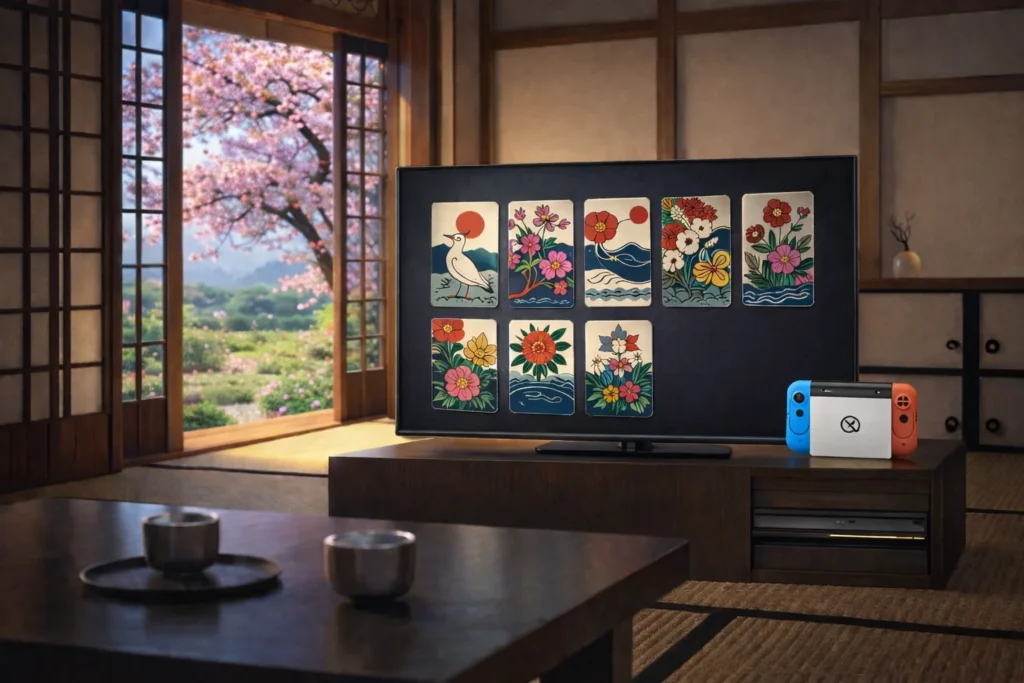
Nintendo’s history is not just the story of a company that has accompanied multiple generations. It is the story of a company that has continually reinvented itself without ever losing its essence. From its beginnings as a handcrafted playing card manufacturer to becoming one of the most influential pillars of the entertainment industry, Nintendo has left an indelible mark on popular culture.
Its impact cannot be measured solely in sales figures or hardware charts. It is measured in shared memories, imagined worlds, and families playing together. It is measured in how it transformed video games from a technical pastime into a true form of interactive art.
With franchises such as Mario, Zelda, Pokémon, Metroid, and Animal Crossing, Nintendo has done more than create successful series it has created cultural icons. Characters recognizable even to those who have never held a controller. Through its consoles, Nintendo has continually redefined what it means to play, embracing unique approaches to design, gameplay, and accessibility.
Today, with the arrival of Switch 2 and a new generation of players, Nintendo once again faces the challenge of balancing innovation with tradition. And if its more than 130-year history has proven anything, it is that Nintendo does not follow trends it creates them.
“While other companies compete to lead the market, Nintendo competes to reinvent it.”